DJI launches Avata 360 drone with 8K capture as rivalry with Insta360 intensifies
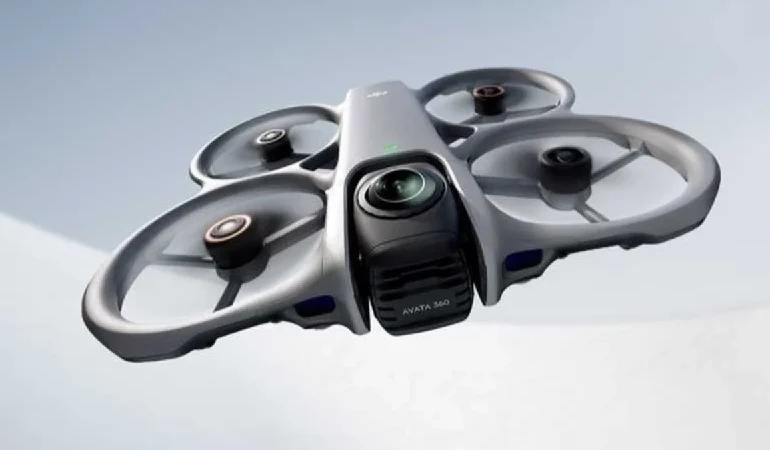
China’s leading drone manufacturer DJI has introduced its first 360 degree drone, marking a significant move into immersive aerial imaging and placing it in direct competition with domestic rival Insta360. The newly unveiled Avata 360 expands DJI’s product portfolio beyond traditional aerial photography by focusing on full field visual capture. The launch comes at a time when the 360 camera segment is gaining momentum globally, driven by demand for virtual reality content, social media storytelling and professional immersive production tools.
The Avata 360 is equipped with an advanced omnidirectional camera mounted at the front, capable of recording high dynamic range video at 8K resolution and 60 frames per second. This allows users to capture an entire scene simultaneously without needing to adjust angles during flight. The drone adopts a compact design with four propellers, visually similar to the Avata 2 first person view model released in 2024. Pricing begins at 4,388 yuan, positioning the product within reach of both enthusiasts and professional creators seeking high quality immersive footage.
The introduction of a 360 degree drone signals a broader shift in how aerial imaging is evolving. Traditional drones typically focus on directional shooting, requiring pilots to manage framing and orientation. In contrast, the Avata 360 removes these limitations by capturing everything in its surroundings, enabling post production flexibility. This approach aligns with growing interest in interactive media formats, where users can explore footage from multiple perspectives. As content consumption habits shift toward immersive experiences, manufacturers are racing to redefine how aerial visuals are captured and presented.
Industry observers note that the launch also reflects intensifying competition between DJI and Insta360, both based in Shenzhen. The rivalry has expanded beyond product innovation into legal territory, with ongoing patent disputes highlighting the strategic importance of 360 imaging technology. While DJI has long dominated the global drone market, Insta360 has built a strong reputation in action cameras and immersive imaging devices. The overlap between these segments is now creating direct competition, pushing both companies to accelerate development and differentiate their offerings.
The emergence of 360 degree drones builds on years of advancements in camera sensors, stabilization systems and real time processing. DJI has historically led in integrating hardware and software ecosystems, giving it an advantage in delivering seamless user experiences. At the same time, Insta360 has focused on compact devices and advanced stitching technology for immersive content. The convergence of these capabilities is shaping a new category where aerial mobility meets full environment capture, opening opportunities in filmmaking, tourism, inspection and digital mapping.
Beyond consumer use, the Avata 360 could find applications in industrial and commercial settings where comprehensive visual data is critical. Infrastructure inspection, real estate visualization and training simulations are among the areas that could benefit from complete spatial capture. The ability to record entire environments in high resolution reduces the need for repeated flights and manual adjustments, improving efficiency and accuracy. As industries adopt digital transformation strategies, tools that offer richer data capture are becoming increasingly valuable.
The timing of DJI’s launch suggests a strategic push to secure leadership in an emerging segment before it becomes saturated. Analysts expect the 360 drone market to grow alongside advancements in virtual reality and augmented reality ecosystems. Companies are investing heavily in technologies that support immersive content creation, and hardware innovations like the Avata 360 are central to that trend. The competitive landscape is likely to evolve quickly as more players enter the space, each seeking to define standards and capture market share.
With the Avata 360 now entering the market, attention will shift to how users respond to its capabilities and how competitors adapt. The intersection of drones and immersive imaging is still in its early stages, but it is rapidly gaining importance within China’s broader technology ecosystem. As innovation accelerates and regulatory frameworks evolve, the next phase of development will likely focus on performance, usability and integration with digital platforms that support next generation visual experiences.