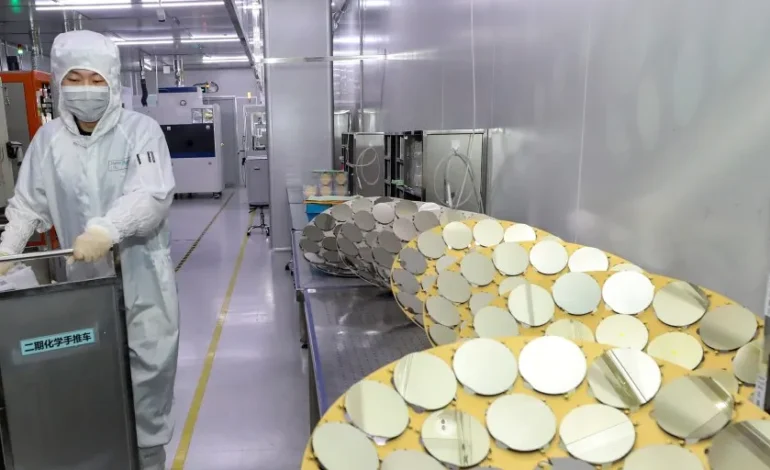
Domestic innovation drives China’s semiconductor push forward

China’s semiconductor industry is increasingly relying on domestic innovation to sustain momentum as access to foreign technology remains constrained. While export controls have limited the availability of advanced tools and chips, they have also intensified efforts within China to build homegrown solutions across design manufacturing and supporting technologies. The result is a gradual but notable shift from reliance on imports toward internally generated progress.
Rethinking innovation priorities
Rather than chasing immediate breakthroughs at the most advanced process nodes Chinese semiconductor firms are focusing on areas where innovation can deliver practical gains. This includes improving chip architectures enhancing energy efficiency and tailoring designs to specific applications such as industrial automation telecommunications and electric vehicles. By aligning innovation with real market needs companies can commercialise products more quickly and generate sustainable revenue.
This pragmatic approach contrasts with earlier strategies that emphasised catching up with global leaders on headline technology metrics alone.
Growth of local chip design capabilities
Domestic chip design has become one of the strongest pillars of China’s semiconductor ecosystem. A growing number of design houses are producing processors for artificial intelligence networking and consumer electronics using locally optimised architectures. These firms are increasingly adept at balancing performance power consumption and cost.
Collaboration between designers and end users has also deepened. Close ties with cloud providers telecom operators and industrial customers help ensure chips are built for actual workloads rather than theoretical benchmarks.
Manufacturing progress at scale
While advanced manufacturing remains a challenge China’s foundries have made steady progress in improving yields reliability and scale at mature nodes. These chips power a wide range of products from smartphones and appliances to industrial equipment and vehicles. Expanding capacity at these nodes reduces supply risks and supports downstream industries.
Incremental improvements in manufacturing processes have helped domestic fabs narrow quality gaps and increase competitiveness even without access to cutting edge lithography.
Packaging and materials as innovation engines
Advanced packaging has emerged as a key area where domestic innovation is accelerating. Techniques that integrate multiple chips into compact modules allow manufacturers to enhance system performance without relying solely on smaller transistors. Chinese firms have invested heavily in chiplet based designs and high density packaging solutions.
Materials science is another area of progress. Local suppliers are developing alternatives for wafers chemicals and specialty materials that were previously imported. While performance differences remain the growing availability of domestic options strengthens supply chain resilience.
Software and tools close the gap
Semiconductor innovation increasingly extends beyond hardware. Chinese companies are investing in software layers including compilers firmware and development frameworks that optimise chip performance. Improvements in electronic design automation tools are also helping designers reduce reliance on foreign software.
These software driven gains allow chips with modest hardware specifications to deliver competitive results in real world applications.
Talent and research networks expand
Universities research institutes and private companies are forming closer partnerships to accelerate innovation. Joint laboratories and industry funded research programmes aim to translate academic work into commercial technology more efficiently. Talent pipelines are being strengthened through targeted training and incentives.
Although experience gaps remain the growing depth of research networks is helping cultivate a new generation of engineers and scientists.
Market driven validation of progress
Domestic innovation is increasingly validated by market adoption. Chinese chips are being deployed at scale in sectors such as renewable energy smart manufacturing and transportation. Successful deployment builds confidence among customers and investors reinforcing the innovation cycle.
This feedback loop between development and deployment is critical for long term competitiveness.
A steady advance rather than a leap
China’s semiconductor push is not defined by sudden breakthroughs but by steady accumulation of capability. Domestic innovation is gradually filling gaps across the value chain reducing dependence on external technology. While challenges remain particularly at the most advanced levels the direction of travel is clear.
By focusing on practical innovation and ecosystem building China is laying the groundwork for a semiconductor industry that can sustain progress even under continued external pressure.