Germany signals openness to EU China trade deal as Europe reassesses economic ties with Beijing
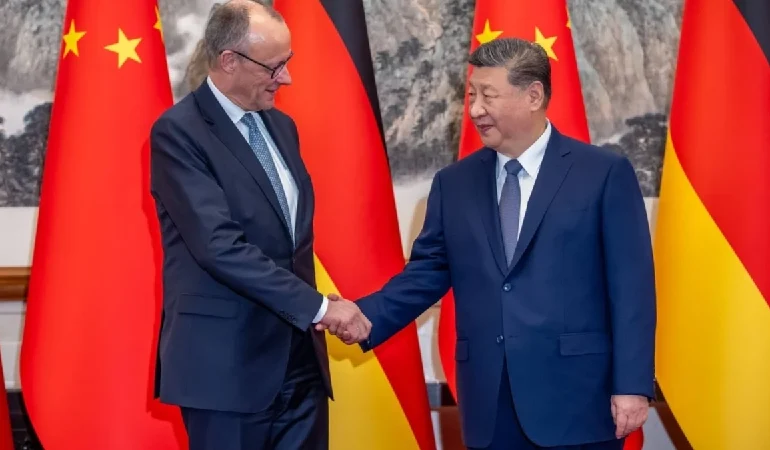
Germany’s leadership has opened the door to a potential future trade agreement between the European Union and China, reflecting a subtle but notable shift in Europe’s approach toward Beijing. Chancellor Friedrich Merz indicated that closer economic cooperation could be considered over the long term, suggesting that evolving geopolitical dynamics are prompting European capitals to rethink their positioning. The remarks come at a time when tensions with the United States and global trade uncertainty are influencing policy decisions across the continent.
Merz stated that ongoing developments in trade policy could eventually lead to broader agreements, including with China, although he acknowledged that such a deal would require time and careful negotiation. His comments highlight growing interest within parts of Europe to maintain strong economic engagement with China, despite existing challenges. The European Union has historically balanced cooperation with caution, particularly in areas involving market access, subsidies and regulatory alignment, making any comprehensive agreement a complex undertaking.
The shift in tone is being driven in part by changing global dynamics, including friction in transatlantic trade relations and increasing economic competition. European economies, particularly export oriented ones like Germany, rely heavily on global markets and are seeking stability amid rising geopolitical pressures. As a result, policymakers are exploring ways to diversify trade partnerships while preserving strategic autonomy, leading to a more pragmatic approach toward China in certain policy circles.
At the same time, European institutions have maintained that the conditions for a formal trade agreement with China are not yet in place. Issues such as fair competition, investment protections and regulatory transparency remain key concerns for Brussels. Previous efforts to deepen economic ties, including investment agreements, have faced political and legal obstacles, reflecting divisions within the bloc over how to engage with China. These challenges suggest that while interest is growing, significant hurdles remain before any deal can materialize.
Analysts say the renewed discussion signals a broader recalibration of Europe’s China strategy rather than a decisive policy shift. Countries across the EU are increasingly weighing economic opportunities against security considerations, particularly in sectors such as technology and critical infrastructure. This balancing act is shaping a more nuanced stance that seeks engagement without overdependence, allowing Europe to adapt to a rapidly changing global environment.
The potential for closer trade ties also reflects the scale of economic interdependence between Europe and China. China remains one of the EU’s largest trading partners, with extensive links across manufacturing, technology and consumer markets. Strengthening these connections could provide economic benefits, but it also raises questions about resilience and long term strategic alignment, especially as global supply chains continue to evolve.
As discussions continue, the focus will be on whether political momentum translates into concrete policy initiatives. The idea of a future trade agreement underscores the importance of flexibility in Europe’s economic strategy, particularly as global alliances shift. Any progress will depend on the ability of both sides to address longstanding concerns while finding common ground in areas of mutual interest, setting the stage for potential changes in the global trade landscape.