
India Formally Labels Delhi Car Explosion a Terror Incident as United States Praises Its Cautious Investigation
India has officially classified last month’s car explosion in New Delhi as a terror incident, marking a major development in a case that has prompted intense scrutiny both at home and abroad. The announcement follows weeks of forensic work, intelligence analysis, and multiple rounds of questioning, as authorities sought to determine whether the blast was a criminal act or part of a wider security threat.
The explosion took place near a busy market area in the capital, shaking nearby buildings and sending smoke into the air. Although casualties were limited, the blast caused widespread alarm, as it occurred in a part of the city that is normally crowded with commuters and families. Footage from the scene showed a vehicle engulfed in flames while emergency responders worked quickly to secure the area.
After its initial review, India’s Ministry of Home Affairs confirmed that the device used in the explosion showed clear signs of intentional construction. Investigators found components consistent with an improvised explosive device, and early analysis suggested a level of planning that went beyond accidental or spontaneous causes. Officials said the classification of the explosion as a terror incident was based on both physical evidence and intelligence assessments.
The announcement coincided with remarks from United States Secretary of State Marco Rubio, who praised India’s approach to the investigation. Speaking to reporters in Washington, Rubio described New Delhi’s handling of the case as “very measured” and “responsible,” noting that Indian authorities took care to avoid premature conclusions while still acting swiftly to secure the city.
Rubio added that the United States continues to monitor the situation closely and remains in close communication with Indian officials. He emphasized that both countries share strong counterterrorism cooperation and regularly coordinate on intelligence matters. His comments were seen as a sign of support for India’s crisis management and a signal that Washington views stability in the region as a shared priority.
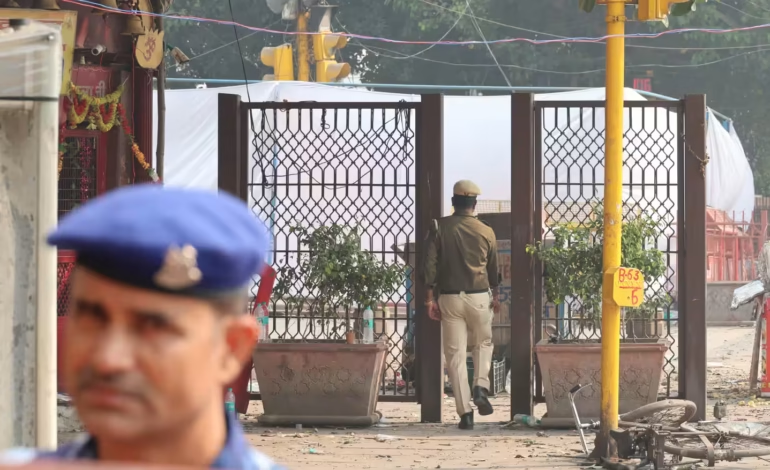
In New Delhi, authorities have increased security in sensitive areas, particularly around government buildings, transportation hubs, and public markets. Additional checkpoints and patrols have been deployed as a precaution while the investigation continues. Officials say several suspects are being examined for possible involvement, although no arrests have been formally announced.
Analysts note that the decision to label the incident as terrorism will likely influence India’s domestic security policies in the months ahead. It may lead to expanded surveillance measures, more aggressive monitoring of extremist networks, and tighter coordination between national and state level security agencies. The case also comes during a period of heightened political tension, adding pressure on the government to demonstrate its ability to protect major cities.
For residents of the capital, the incident has revived anxieties about safety in public spaces, even as life largely continues as normal. Authorities have urged the public to remain vigilant but calm, stressing that there is no evidence of an ongoing threat.
As the investigation proceeds, India is expected to release further details in the coming weeks. For now, officials say the priority is to identify those responsible and ensure that similar attacks cannot be carried out in the future.



