Innovation and exports will reshape China’s car industry in 2026
A pause after years of rapid expansion
China’s car industry is entering a year of consolidation after a long period of breakneck growth. While new energy vehicles are expected to continue gaining market share, overall momentum is slowing as the sector pauses to absorb excess capacity and falling margins. Industry forecasts suggest NEV penetration will reach around 60 percent, a milestone that confirms electrification is no longer a niche trend. Yet growth rates will be far more modest than in previous years, reflecting a maturing market and tougher economic conditions.
Domestic demand is expected to remain subdued through much of 2026. Consumer confidence has been dampened by a sluggish economy and a cautious wait and see attitude among buyers. As a result, first half vehicle sales are likely to trail last year’s levels, with full year growth capped at roughly 3 percent at best.
Involution continues to weigh on profitability
The dominant theme hanging over the industry remains involution, the destructive cycle of intense competition that erodes pricing power and profits. Despite policy guidance and calls for discipline, manufacturers continue to undercut each other to defend market share. This pressure has had a visible impact on financial performance.
From January to November, the average profit rate across the sector stood at just 4.4 percent, barely above the record low recorded in 2024. For many manufacturers, scale alone is no longer enough to guarantee survival. Margins are thin, inventories are high, and smaller players are increasingly squeezed.
Exports become the main profit engine
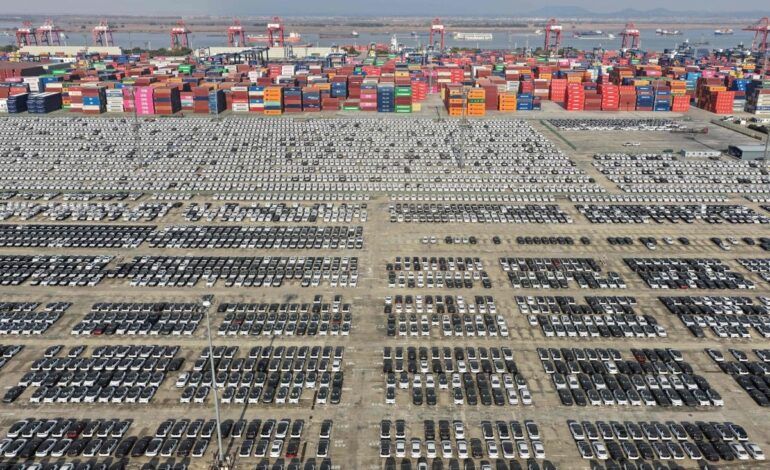
With domestic sales offering limited relief, exports are emerging as the most important lever for profitability. Chinese carmakers have rapidly expanded overseas, targeting markets in Europe, Southeast Asia, the Middle East, and Latin America. Competitive pricing, improving quality, and a strong NEV offering have helped Chinese brands gain traction abroad.
Exports allow manufacturers to run plants at higher utilisation rates while escaping the fiercest price wars at home. For 2026, analysts expect export growth to offset flat domestic sales, making international markets critical to earnings stability. Companies that fail to build a credible export strategy may struggle to remain viable.
Chips replace batteries as the next battleground
While batteries have long been seen as the core technology differentiator in electric vehicles, attention is shifting toward semiconductors. Advanced driver assistance systems, smart cockpits, and autonomous features are becoming key selling points, increasing demand for specialised automotive chips.
Control over chip supply and design is likely to shape competitiveness in the coming years. Manufacturers that can secure reliable access to advanced semiconductors or develop in house capabilities will be better positioned to differentiate their products. This shift also reflects broader efforts to reduce vulnerability to global supply chain disruptions.
Consolidation focuses on the battery sector
Despite widespread pressure, large scale consolidation across the entire car industry remains unlikely in the near term. Instead, consolidation is expected to be concentrated in the battery segment, where overcapacity and falling prices have made survival increasingly difficult for smaller producers.
Battery makers face intense competition and heavy capital requirements, making mergers and exits more likely. In contrast, vehicle manufacturers may continue operating even with low margins, supported by local governments, export ambitions, or strategic importance.
Innovation separates winners from survivors
In this tougher environment, innovation is becoming the primary differentiator. Incremental improvements are no longer sufficient. Carmakers must deliver advances in efficiency, software integration, and user experience to justify pricing and maintain relevance.
Those that succeed will likely be firms capable of combining technological depth with global market access. Companies that rely solely on domestic demand or outdated platforms risk being left behind as the industry evolves.
A year of selection rather than expansion
The coming year will not be defined by explosive growth, but by selection. China’s car industry is entering a phase where weaker players are exposed and stronger ones refine their strategies. Exports, innovation, and control over key technologies will determine who emerges with sustainable profits.
By the end of 2026, the sector may look leaner and more disciplined. While the road ahead remains challenging, this period of adjustment could ultimately produce a healthier industry built on competitiveness rather than sheer volume.