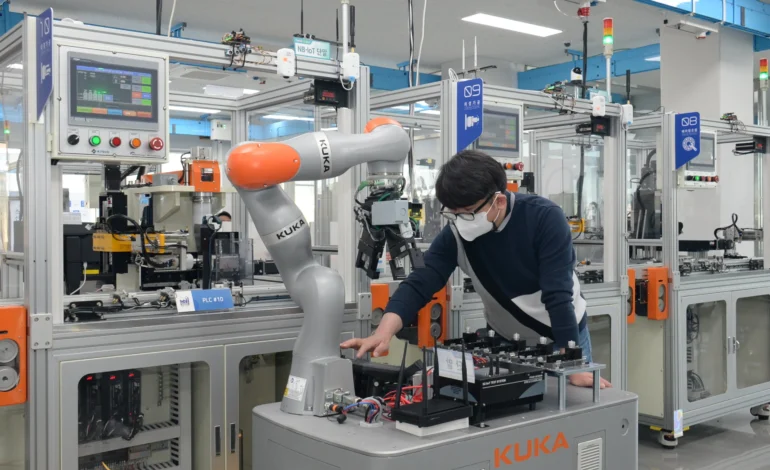
Machine-to-Machine Payments: The Future of Autonomous Industrial Finance
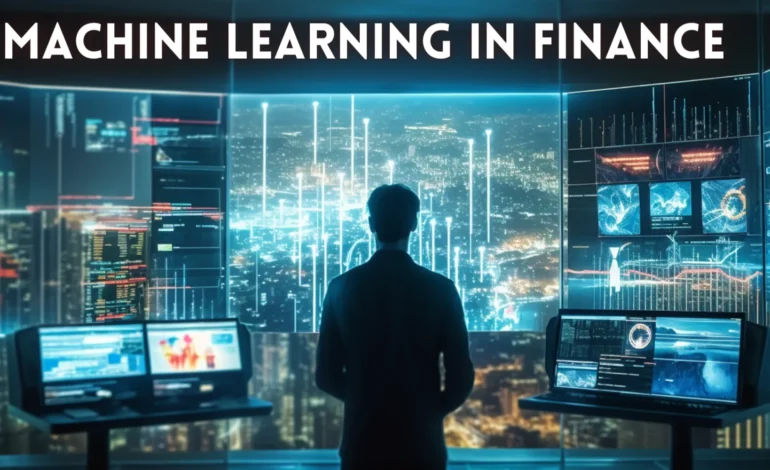
As China advances toward a fully intelligent manufacturing economy, a new form of financial infrastructure is emerging: machine-to-machine (M2M) payments.
This concept allows automated systems, robots, and industrial devices to execute verified financial transactions with no human intervention.
In manufacturing zones such as Shenzhen, Suzhou, and Chongqing, M2M payment frameworks are now being integrated into factory operations, linking production data with financial settlement systems.
According to the China Academy of Information and Communications Technology (CAICT), M2M financial automation could reduce transaction latency by up to 80 percent while improving transparency across industrial supply chains.
How Machine-to-Machine Payments Work
M2M payments function through programmable transaction protocols that connect industrial devices to digital finance systems.
Every robotic unit, conveyor belt, or automated vehicle is assigned a digital identity within a secure ledger.
When two machines exchange goods, services, or data, the transaction is automatically verified by sensors and logged into a distributed financial record.
Once performance metrics are validated, such as completion time, accuracy, or resource use, payment triggers are activated, and funds are transferred instantly.
This innovation transforms how factories, suppliers, and logistics partners interact, replacing manual reconciliation with self-executing financial systems.
Integration of AI and Blockchain Infrastructure
Artificial intelligence and distributed ledger systems form the foundation of M2M payment technology.
AI algorithms assess performance data, detect anomalies, and authorize payment execution only when predetermined conditions are met.
Meanwhile, blockchain-based ledgers ensure that each transaction remains tamper-proof and auditable, providing a transparent record for manufacturers and regulators.
In practical terms, this infrastructure enables machines from different companies or even different countries to collaborate securely through a shared financial protocol.
Such systems also support programmable microtransactions, allowing equipment to pay for incremental resource consumption such as electricity or bandwidth in real time.
Industrial Efficiency and Real-Time Liquidity
The adoption of M2M payments significantly improves liquidity management and operational efficiency across industrial networks.
Factories can automate payments for component deliveries the moment goods arrive, while logistics vehicles can trigger toll payments as they move through smart highways.
These processes eliminate the delays typically caused by manual invoicing and human approval systems.
Manufacturers report cost savings of up to 25 percent in transaction management due to automation and reduced administrative overhead.
By synchronizing production data and financial operations, M2M payments create a seamless cycle of continuous value exchange.
Policy Alignment and Institutional Support
The Chinese government has identified machine-level financial automation as part of its broader Digital Economy Development Plan.
The People’s Bank of China (PBoC) and the Ministry of Industry and Information Technology (MIIT) are supporting pilot programs that integrate programmable finance into industrial production zones.
Local banks in Jiangsu and Guangdong are experimenting with modular transaction networks that enable manufacturers to settle payments using verified industrial data.
These initiatives ensure compliance with national data governance and cybersecurity standards while promoting innovation across multiple sectors.
By embedding financial logic within manufacturing infrastructure, policymakers are enabling factories to function as self-financing, data-driven ecosystems.
Challenges and Future Prospects
Despite its promise, M2M payment technology faces challenges related to interoperability, data privacy, and regulatory harmonization.
Different industrial systems use varying communication protocols, making cross-platform synchronization complex.
Cybersecurity remains another concern, as automated payment systems must protect against unauthorized access or manipulation.
To address these risks, China is developing unified technical standards that define how machines communicate, verify data, and conduct financial operations securely.
Experts predict that by 2027, most advanced industrial parks will operate on hybrid financial frameworks where both human-managed and machine-executed payments coexist.
Conclusion
Machine-to-machine payments mark a turning point in the evolution of industrial finance.
By combining artificial intelligence, digital verification, and programmable settlements, China is creating factories that can not only produce autonomously but also manage their own financial workflows.
This convergence of technology and finance reflects a future where every component of the manufacturing ecosystem, from robotic arms to logistics fleets, participates in real-time economic activity.
As the digital economy matures, M2M payments may become the invisible infrastructure powering the next era of industrial efficiency and financial transparency.