Macron Calls for EU Retaliation as Trump Escalates Pressure on Allies
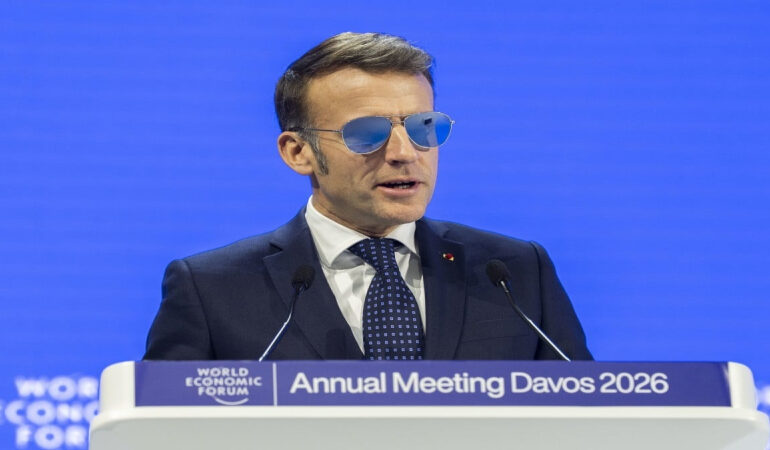
French President Emmanuel Macron has urged the European Union to respond forcefully to growing pressure from the United States, warning that failure to act would leave Europe vulnerable to coercion in an increasingly unstable global order. Speaking at the World Economic Forum in Davos, Macron argued that recent US threats tied to Greenland and trade policy reflect a broader erosion of international norms. He cautioned that Europe risks sliding into a system dominated by power politics rather than rules if it does not defend its interests. Macron framed the moment as a test of European sovereignty, stressing that passivity would amount to accepting strategic dependence. His remarks came amid renewed tensions triggered by Washington’s stance on Greenland and its willingness to use tariffs as leverage, unsettling transatlantic relations and forcing European leaders to reassess their response options.
Macron specifically called on the EU to consider deploying its anti coercion instrument, a powerful mechanism that allows the bloc to retaliate against economic pressure through tariffs, quotas or market restrictions. The tool has never been used before and would require approval by the European Commission and a majority of member states, making its activation a significant political step. Macron described it as irrational that Europe could find itself compelled to use such measures against the United States, but argued that the credibility of EU trade policy depends on a willingness to act. His comments highlight a growing view among some European leaders that strategic autonomy must extend beyond defence into trade and economic policy. The debate underscores divisions within the EU, with some officials favouring a more cautious approach to avoid deepening confrontation with Washington.
The speech also carried implications beyond Europe’s relationship with the United States. Macron linked US pressure to broader global challenges, including industrial competition and the reshaping of supply chains, warning that unchecked coercion accelerates fragmentation into rival blocs. His warning of a world moving away from shared rules resonates with concerns in Beijing and other capitals about the durability of the existing global trade system. For Europe, the immediate challenge lies in balancing deterrence with dialogue, while maintaining unity among member states with differing economic and security priorities. Macron’s intervention signals that the debate over how far Europe is willing to push back against its closest ally is entering a more explicit and confrontational phase.