Meet AMIES, China’s New Contender in Reducing Reliance on ASML’s Chipmaking Tools
China’s long-standing challenge in advanced chip manufacturing has always centered on lithography, the crucial process that defines how small and powerful semiconductors can become. With access to ASML’s most advanced machines cut off by US export rules, China has been searching for domestic breakthroughs. Now, a new company, AMIES Technology, founded earlier this year, is drawing widespread attention and offering renewed hope that the country may be closer to building more competitive lithography tools of its own.
Showcasing Ambition on a Big Stage
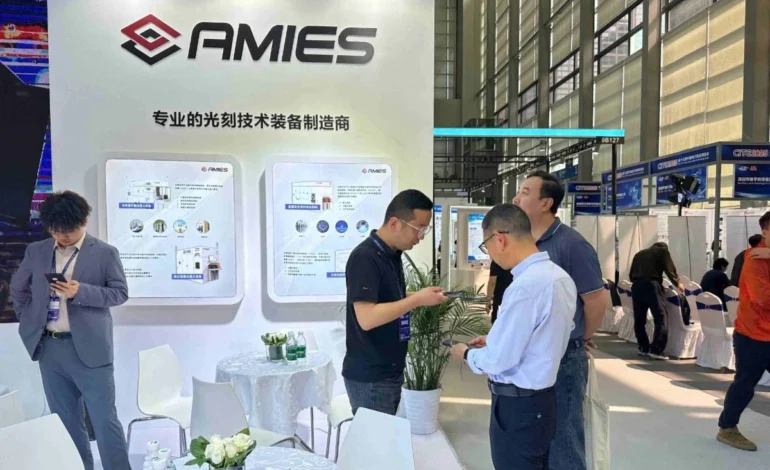
AMIES made its public debut at the WeSemiBay Semiconductor Ecosystem Expo 2025 in Shenzhen, one of the industry’s largest annual gatherings. The company showcased an impressive lineup of products that signal deep ambitions. Its exhibition included compound semiconductor lithography machines, laser annealing systems, advanced inspection equipment, packaging solutions, and wafer bonding tools. With more than six hundred exhibitors in attendance, including major Chinese technology partners such as SiCarrier, AMIES managed to stand out as one of the most closely watched newcomers.
Lithography: China’s Persistent Technological Bottleneck
Despite rapid progress across many parts of the semiconductor supply chain, China still faces a significant gap in advanced lithography technology. Tools at the forefront of chipmaking, especially deep ultraviolet and extreme ultraviolet systems, remain out of reach because of strict export controls led by the United States. These machines, produced exclusively by ASML, are essential for creating chips at cutting-edge nodes. Without access to them, China’s most advanced fabs must rely on older technologies that limit how small and efficient their chips can be. This bottleneck has become one of the most strategic concerns in China’s push for semiconductor self-reliance.
A Spin Off With Strategic Purpose
AMIES is not starting from scratch. The company is a spin off from Shanghai Micro Electronics Equipment, China’s leading lithography company. SMEE, a state owned firm, has been at the center of China’s lithography development efforts for years. While SMEE continues to focus on core front end technology, AMIES was created to commercialize equipment more rapidly and bring new machines to market at a faster pace. According to Chinese media reports, the two companies are expected to complement one another, with SMEE focusing on fundamental breakthroughs and AMIES taking those innovations into scalable production.
Strengths and Limitations of China’s Existing Lithography Tools
SMEE has achieved meaningful progress, particularly in back end semiconductor processes such as packaging, where lithography requirements are less demanding. However, when it comes to front end wafer fabrication, the company still lags behind global leaders. SMEE’s most dependable production grade systems are widely believed to support around the ninety nanometre node or above, which is far from the advanced nodes used in leading edge consumer electronics. In 2023, the company briefly made headlines when its shareholder Zhangjiang Group claimed that SMEE had successfully developed a twenty eight nanometre lithography machine, only for the statement to be retracted shortly after. The incident highlighted both the intense national expectation and the difficulty of achieving breakthroughs in such a complex field.
Why AMIES Is Generating Hope
What makes AMIES noteworthy is not only its relationship to SMEE but its market oriented approach. China’s semiconductor industry has long been criticized for slow commercialization cycles and challenges translating research into scalable equipment. AMIES aims to bridge that gap by focusing on bringing competitive lithography tools to customers more quickly. Its broad product portfolio implies a strategy of entering multiple segments of the lithography and semiconductor equipment chain at once, building expertise and revenue while pursuing more advanced systems over time.
A Long Road Ahead, but Signs of Progress
Experts note that China still has a long way to go before it can match ASML’s decades of accumulated intellectual property, engineering experience and deep relationships with the world’s leading chipmakers. Developing a working extreme ultraviolet system remains an enormous challenge for any country. Even so, the emergence of companies like AMIES shows that China is expanding the number of players tackling these problems. As investment flows in and engineering teams grow, capabilities can evolve more rapidly.
The Bigger Picture for China’s Chipmaking Future
AMIES’ rise reflects a broader national strategy. China is diversifying its semiconductor toolkit, strengthening domestic supply chains and supporting companies that can eventually reduce reliance on foreign technology. While AMIES alone cannot close the gap with ASML, it represents a new stage in China’s efforts: more specialized firms, more aggressive commercialization and more confidence that breakthroughs are possible. For an industry where progress is measured in nanometers but requires years of effort, every new contender counts.