Nexperia Customers Seek Workarounds as Europe China Chip Tensions Intensify
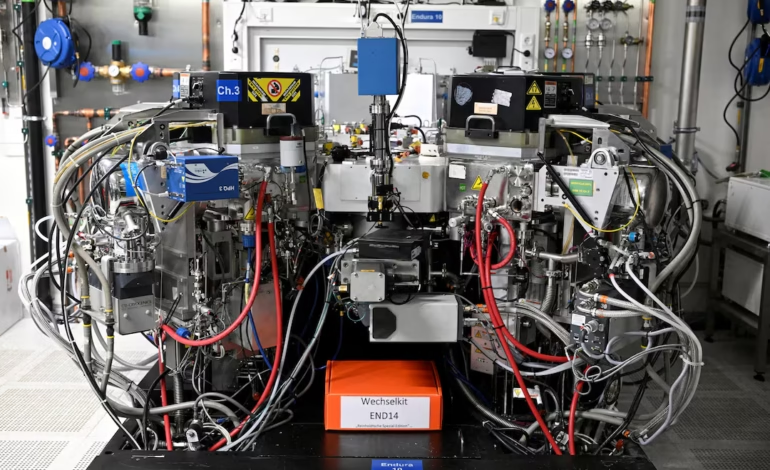
Clients of Nexperia, the Chinese owned semiconductor firm facing mounting pressure in Europe, are exploring alternative arrangements to keep their supply chains functioning amid deepening political and regulatory tensions, according to sources familiar with ongoing discussions. The conversations reflect growing anxiety across the technology sector as Europe and China confront one another over national security concerns and the future of advanced manufacturing.
The Netherlands recently moved to seize part of Nexperia’s operations, citing security risks connected to Chinese ownership. This decision has sent shockwaves through the global electronics industry, where Nexperia is a major supplier of essential components used in everything from smartphones and electric vehicles to industrial equipment.
Multiple industry sources told reporters that several of Nexperia’s European customers have begun considering quiet workarounds designed to preserve access to the company’s chips without directly violating new regulatory limits. The talks reportedly involve exploring indirect supply chains, shifting assembly locations, and restructuring partnerships to maintain a flow of components while avoiding confrontation with European authorities.
One source described the mood among clients as “nervous but determined,” noting that disruptions to Nexperia’s operations could create serious bottlenecks. Even small shifts in semiconductor supply chains can ripple across manufacturing sectors, potentially delaying production, raising costs, and forcing companies to rethink long standing supplier relationships.
The situation highlights the increasingly complex environment facing firms caught between European security policies and China’s expanding influence in the global technology market. European officials insist that stronger oversight is necessary to protect national interests and prevent foreign control over key parts of the semiconductor sector. China, in turn, has criticized the seizure of Nexperia assets as discriminatory and politically motivated.
Analysts say the rising tensions illustrate the difficult balancing act European companies must navigate. On one hand, governments are tightening rules on foreign investment and introducing new frameworks to limit reliance on Chinese technology. On the other hand, manufacturers remain heavily dependent on Chinese owned suppliers whose components are deeply embedded in international supply chains.
Several experts believe that if the dispute escalates further, it could accelerate efforts by companies to diversify or redesign their supply networks. This includes sourcing from more geographically aligned partners or shifting toward domestic or allied production hubs. However, building new semiconductor capacity is expensive and takes years, making rapid adjustments nearly impossible.
For now, Nexperia continues to operate, but uncertainty hangs over its future in Europe. Customers are watching closely for signals from both Beijing and Brussels, aware that any decision implemented in the coming months could reshape semiconductor flows across the continent.
The broader geopolitical context also remains volatile, as Europe’s desire to safeguard strategic technologies collides with China’s ambition to maintain influence in global manufacturing. Businesses caught in the middle are preparing for prolonged complications, with some already taking steps to shield themselves from future restrictions.
As discussions continue behind closed doors, one thing is clear: the interplay between politics and technology is growing stronger, and companies on both sides of the divide must adapt or face significant disruption.