
Nio doubles down on battery swapping with US$2.6 billion expansion despite fast charging pressure
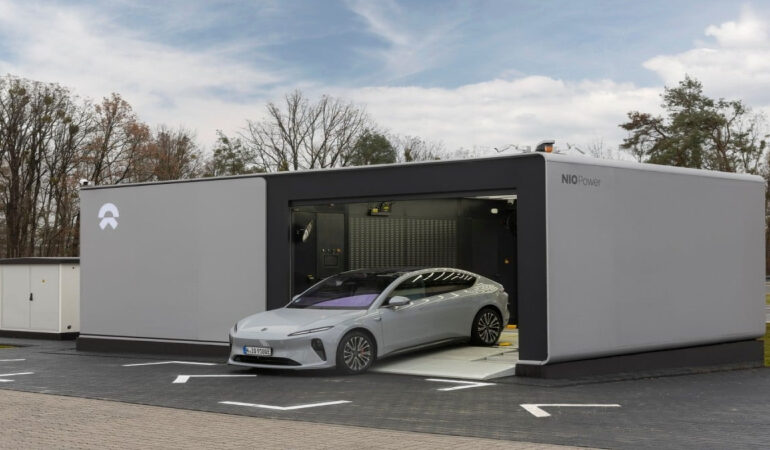
China’s electric vehicle maker Nio is pushing ahead with an ambitious expansion of its battery swapping network, raising US$2.6 billion to reinforce a technology it believes still has a long-term role in the country’s fast evolving EV market. The Shanghai based company says it will add 1,000 new battery swapping stations across China this year, building on a system that has already completed 100 million swaps nationwide.
Nio’s strategy is rooted in its belief that convenience and speed remain critical for mass EV adoption. Its current network of 3,729 stations allows compatible vehicles to replace depleted battery packs with fully charged ones in about three minutes, with most of the process handled automatically by the vehicle and station. The company originally designed the system to address consumer concerns around driving range and long charging times, issues that were especially acute in the early years of China’s EV rollout.
William Li, Nio’s co founder and chief executive, said the 100 million swap milestone shows that battery swapping has moved beyond experimentation and is now widely accepted by drivers as a practical energy replenishment option. He argued that swapping should be seen as a core alternative alongside home charging, workplace charging, and public fast charging, rather than as a niche solution.
Nio is currently the only mainland Chinese carmaker producing vehicles designed specifically for battery swapping, but it has been working to broaden the ecosystem. Partnerships with automakers such as Geely and FAW aim to standardize technology and encourage wider industry participation. These collaborations are intended to spread development costs and accelerate adoption beyond Nio’s own customer base.
Despite these efforts, battery swapping faces growing competition from rapid advances in charging technology. Ultra fast charging batteries now allow some premium electric vehicles to gain up to 500 kilometers of driving range in roughly 10 minutes, significantly narrowing the time advantage that swapping once enjoyed. Industry executives say this shift could influence consumer preferences, especially as fast charging infrastructure becomes more widespread.
Davis Zhang, a senior executive at a specialized battery supplier in eastern China, noted that battery swapping has established itself as a viable option, but its future depends on whether it can scale to millions of new vehicles. He added that ultra fast charging is gaining popularity and may reduce the appeal of swapping for drivers who value simplicity over infrastructure specific solutions.
Nio launched its first battery swap station in Shenzhen in 2018 and has since invested about 18 billion yuan in developing the technology. While the company acknowledges the challenges ahead, it continues to position swapping as a long term pillar of its business model and a differentiator in China’s intensely competitive EV market.



