Nvidia Eyes Renewed China Market Access as Xi–Trump Talks Revive Chip Diplomacy
U.S. semiconductor giant Nvidia is positioning for a potential return to the Chinese market as expectations rise that President Donald Trump and President Xi Jinping could reach a new understanding on advanced technology exports.
The optimism follows reports that Trump raised the issue of Blackwell-series AI chips during recent discussions with Xi, signalling a possible recalibration of Washington’s restrictions on high-performance processors sold to China.
Shares of Nvidia climbed to record highs this week, with investors betting that an easing of curbs would restore the company’s access to the world’s second-largest market for artificial intelligence hardware. The U.S. firm has faced export controls since 2022, when Washington tightened rules on chips deemed critical to advanced computing and military applications.
Strategic value of China’s AI ecosystem
For Nvidia, China remains central to its long-term growth. The country accounts for an estimated 20 to 25 percent of global demand for AI-capable semiconductors, driven by rapid expansion in cloud computing, autonomous driving, and large-language-model development.
Industry analysts in Beijing say a partial policy relaxation would benefit both sides by stabilising the global AI supply chain and supporting collaboration in civilian research sectors.
“China is the single largest test bed for applied AI,” said Liu Cheng, a researcher at the Institute for Information Industry Development. “Limiting chip flows not only constrains China’s innovation capacity but also disrupts global hardware efficiency.”
Nvidia’s strategy and diplomatic backdrop
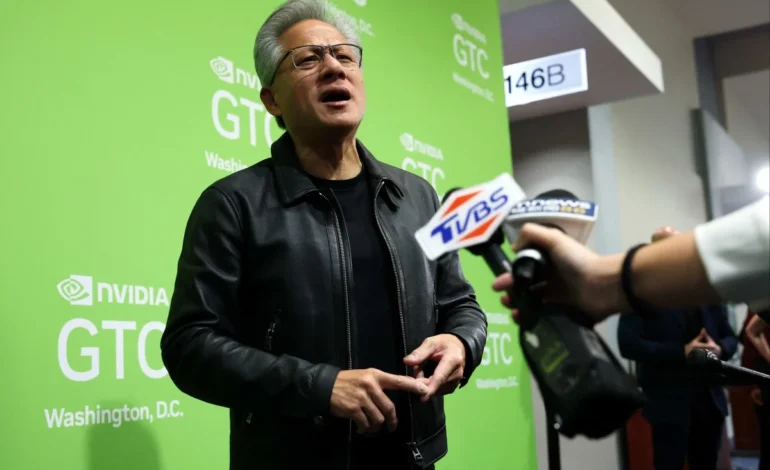
Nvidia CEO Jensen Huang has repeatedly expressed confidence that the company can work within regulatory boundaries while serving Chinese clients through customised, compliant chips.
Speaking at a tech forum in Singapore, Huang said he remained “optimistic about constructive engagement between both governments,” adding that cooperation on AI infrastructure could “benefit the entire global economy.”
His comments came as Washington and Beijing reopened high-level communication channels on trade and technology, including working groups on semiconductor policy. Trump’s team has hinted that a pragmatic arrangement could emerge, allowing U.S. companies limited participation in non-military AI hardware sales under strict licensing conditions.
China’s policy stance on technological autonomy
Chinese officials have not publicly commented on Nvidia’s prospects, but state media have reiterated Beijing’s determination to advance indigenous chip development while maintaining openness to “mutually beneficial technology trade.”
Analysts said this dual approach allows China to safeguard its long-term strategic independence while engaging selectively with foreign suppliers that support industrial upgrading and research collaboration.
“Nvidia’s technology remains valuable for short-term innovation cycles,” said Chen Kai, a semiconductor policy expert at Tsinghua University. “However, China’s industrial policy continues to prioritise local capacity building to reduce external vulnerability.”
Market and regional implications
The possibility of renewed chip sales has lifted semiconductor stocks across Asia, with suppliers in Taiwan, South Korea, and mainland China reporting increased orders for AI-related components.
Investors believe that any improvement in U.S.–China technology dialogue could ease tensions in the global electronics sector and reduce uncertainty in cross-border supply chains.
While Washington’s export controls are unlikely to be fully lifted, industry observers expect a phased licensing regime that would permit limited shipments of downgraded chips for commercial use in China’s fast-growing AI and cloud-computing industries.
Such a framework would align with Beijing’s call for “balanced technological cooperation” that supports development while maintaining security safeguards.