Robotics Diplomacy: How China Exports Smart Machines to the Global South

China’s technological influence is expanding far beyond its borders, and robotics has become one of its most powerful instruments of diplomacy. In 2025, Chinese companies are exporting industrial and service robots to dozens of countries across Asia, Africa, and Latin America, reshaping how emerging economies automate production and deliver public services. Through what analysts now call “robotics diplomacy,” China is building long-term partnerships that combine trade, technology, and soft power, positioning itself as a global leader in intelligent manufacturing and development cooperation.
Technology as a Tool of Foreign Policy
China’s push to export robotics technology aligns with its broader vision for the Digital Silk Road, the technological branch of the Belt and Road Initiative (BRI). According to Nikkei Asia, Chinese robotics firms such as Siasun, DJI, and EFORT have established operations in more than 40 countries, providing automation solutions in manufacturing, logistics, agriculture, and healthcare.
These exports are not just commercial deals but part of strategic government-to-government frameworks. SCMP reports that China’s Ministry of Commerce supports robotics projects through concessional financing and joint R&D programs with partner nations. The result is a new model of cooperation that blends technology transfer with industrial training, enabling developing economies to leapfrog into the age of intelligent automation.
Industrial Robotics and Global Manufacturing Shifts
One of the most visible outcomes of robotics diplomacy is the modernization of factories in developing markets. In countries such as Egypt, Indonesia, and Kenya, Chinese-built automated assembly lines are increasing productivity and reducing dependence on imported machinery from Western manufacturers.
Reuters notes that Chinese industrial robots, which cost up to 30 percent less than their European or Japanese counterparts, are becoming the preferred choice for local manufacturers. Many of these systems use AI-driven visual sensors and cloud-based maintenance platforms designed in Shenzhen and Suzhou. These technologies allow remote monitoring and predictive repairs, lowering downtime and operational costs for small and medium-sized enterprises in emerging markets.
Service Robots in Public Infrastructure and Healthcare
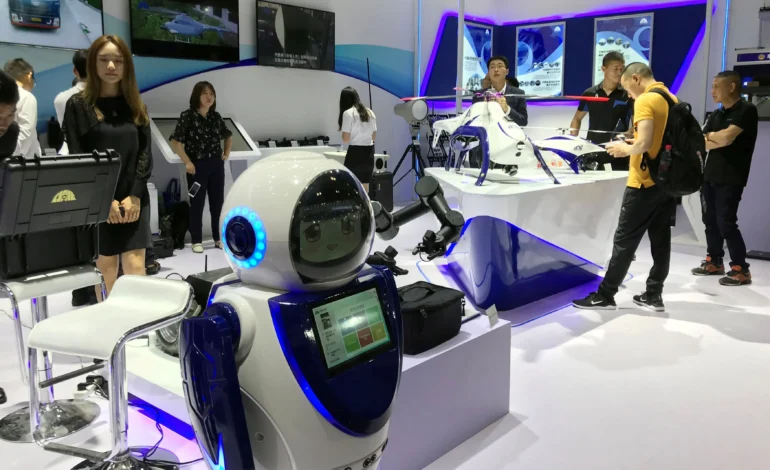
Beyond factories, service robotics has become another pillar of China’s export strategy. CGTN highlights that Chinese-made service robots are now deployed in public hospitals, airports, and transport hubs across the Middle East and Africa. These robots perform tasks such as patient assistance, airport security, and facility disinfection applications that gained urgency after the global pandemic.
Chinese firms are also customizing products for local needs. In Latin America, for example, agricultural robots developed by China’s Nanjing Institute of Automation are helping farmers optimize irrigation and crop monitoring. These initiatives demonstrate how robotics technology is being adapted to regional conditions rather than exported as one-size-fits-all solutions.
Training, Talent, and Knowledge Transfer
Robotics diplomacy extends well beyond hardware delivery. It includes education, skill development, and collaborative research. According to The Diplomat, China has launched over 20 Robotics and AI Training Centers across Africa and Southeast Asia, often in partnership with local universities. These centers provide hands-on instruction in mechatronics, coding, and industrial automation, helping to build local expertise while deepening China’s technological ties with partner countries.
This talent-oriented strategy serves dual purposes: it creates employment opportunities in developing economies while reinforcing China’s image as a cooperative innovation partner rather than a purely commercial supplier. The training programs also ensure that the technology exported abroad remains sustainable and adaptable in local contexts.
Economic and Strategic Benefits
The economic benefits of China’s robotics diplomacy are substantial. DW reports that exports of robotics and automation equipment from China reached nearly $30 billion in 2024, with Africa and Southeast Asia accounting for the fastest growth. These exports support China’s industrial overcapacity management while generating global demand for its AI software and cloud services.
Strategically, robotics diplomacy enhances China’s influence in regions traditionally dominated by Western technology providers. By offering affordable, scalable, and adaptable solutions, China is creating long-term dependencies in high-tech infrastructure. This form of soft power strengthens political goodwill and opens new markets for related products such as electric vehicles, digital finance, and smart city systems.
Challenges and the Road Ahead
Despite its success, robotics diplomacy faces several challenges. Competing interests among recipient nations, data security concerns, and uneven local infrastructure can slow adoption. Reuters notes that some governments remain cautious about technology dependence and are pushing for greater transparency in data governance.
China’s response has been to emphasize mutual technological sovereignty, promoting open-source standards and localized data control. This cooperative stance helps reassure partners while differentiating China’s model from Western export frameworks, which often come with stricter political or contractual conditions.
Conclusion
Robotics diplomacy represents a new frontier in China’s global engagement, one that combines innovation, development, and diplomacy in a single framework. By exporting automation systems, training talent, and promoting inclusive technology, China is shaping the industrial future of the Global South. This strategy not only strengthens economic ties but also redefines the meaning of soft power in the 21st century. As developing countries embrace automation, China’s intelligent machines are becoming ambassadors of a new era of global cooperation.