Russian oil tankers increasingly cite Singapore as a destination as exports pivot toward China.
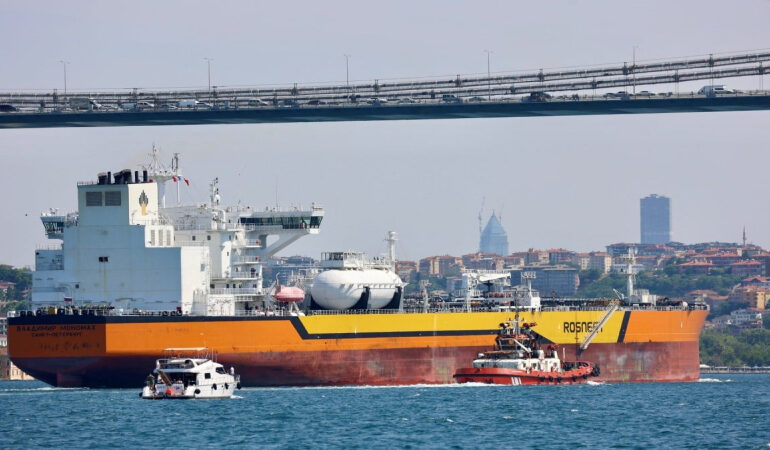
Russian oil shipments are increasingly listing Singapore as their official destination, a trend that traders say reflects both heightened sensitivity to Western sanctions and a quiet shift in crude export flows away from India and toward China. Shipping data indicates that the change is less about Singapore as an end market and more about logistics, signaling how Russian energy exports are adapting under continued geopolitical pressure.
According to data compiled bythe London Stock Exchange Group, tankers carrying roughly 1.4 million metric tons of Russian crude oil departed with Singapore listed as their destination in January. That volume represents the highest monthly level recorded in recent years, underscoring how frequently the city state is now appearing in shipping documentation linked to Russian oil movements.
Singapore itself does not import Russian crude due to compliance risks tied to international sanctions. However, traders say its surrounding waters are often used as a neutral maritime zone for ship to ship transfers. In these operations, oil cargoes can be moved between vessels, blended, or redirected before continuing onward to final buyers, making the ultimate destination less transparent during the initial leg of the journey.
Market participants note that this routing strategy has become more common as scrutiny over Russian oil flows intensifies. By listing Singapore, shippers gain flexibility while reducing the visibility of final destinations at a time when enforcement of price caps and sanctions remains uneven but persistent. The practice also reflects a broader recalibration of Russian export routes since Europe sharply reduced its purchases of Russian crude.
India had emerged as a major buyer of discounted Russian oil in recent years, but traders say flows toward Chinese refiners have been gaining momentum again. China’s large and diversified refining system is better positioned to absorb irregular supply streams, particularly when shipments involve complex logistics or indirect routing. The use of Singapore as a waypoint helps facilitate this transition without explicitly naming Chinese ports at the outset.
The data highlights how Russia’s energy trade is increasingly reliant on maritime workarounds rather than direct bilateral routes. Tankers operating under Russian flags or linked to Russian producers are facing higher insurance costs, stricter compliance checks, and limited access to Western shipping services. As a result, exporters are leaning more heavily on alternative hubs and longer transport chains to maintain volumes.
Analysts say these patterns illustrate the durability of Russian crude exports despite sanctions, but also their growing inefficiency. Longer routes, ship to ship transfers, and additional handling all add costs and operational risks. At the same time, the willingness of buyers in Asia to engage with such arrangements shows that global oil markets remain highly adaptive.
As sanctions persist and geopolitical divisions deepen, shipping data is likely to continue offering clues about how energy flows are being reshaped. The rising appearance of Singapore in Russian oil маршруtes points to a trade system that is becoming less direct, more opaque, and increasingly centered on Asia.