
SAP CEO Urges Unified Europe and Smarter AI Regulations to Compete Globally
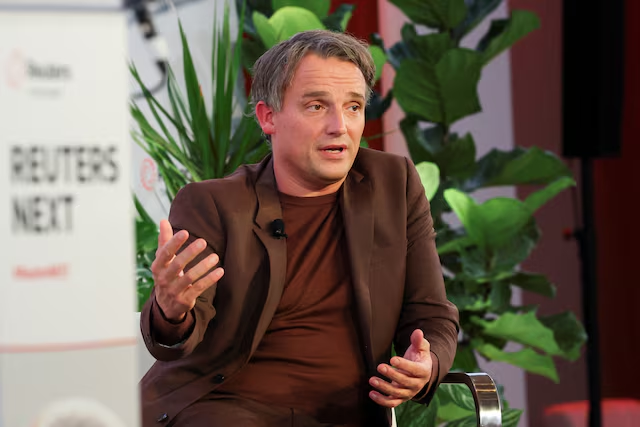
SAP Chief Executive Officer Christian Klein has called on European leaders to create a more unified digital market and reduce regulatory barriers in order to remain competitive in the global artificial intelligence race. Speaking at the Reuters NEXT conference in New York on December 4, Klein stressed that Europe’s internal fragmentation and overregulation are hindering its ability to lead in next-generation technologies.
In a pointed critique, Klein said Europe was “standing in its own way” by pushing ahead with complex AI compliance regimes before the region’s startups and research ecosystems have had time to scale effectively.
“We need more Europe, but we need a united Europe. We need much less regulation,” Klein said. He argued that while the European Union plays a crucial geopolitical role in maintaining democratic values in tech governance, it is currently failing to provide the flexibility needed for early-stage AI innovation to flourish.
While acknowledging the importance of safeguarding public interests, Klein suggested that Europe’s heavy-handed approach, especially through upcoming legislation like the Artificial Intelligence Act, risks stifling innovation at a critical juncture. “We are regulating where nothing has to be regulated,” he stated, advocating for a more nuanced policy that distinguishes between foundational research and high-risk AI applications.
Klein’s comments come at a pivotal time for European digital policy. The European Commission recently proposed delaying the enforcement of some of the strictest AI rules, including those related to biometric identification and algorithmic decision-making in hiring and healthcare. Under the revised proposal, these high-risk provisions would now come into force in December 2027 instead of August 2026.
The proposal, dubbed the “Digital Omnibus,” also aims to consolidate several overlapping technology regulations and modernize aspects of the General Data Protection Regulation (GDPR). If implemented, the reform would allow companies like Meta, Google, and OpenAI to use limited personal data for AI model training under defined safeguards.
Beyond legal reform, Klein emphasized that Europe should focus on areas of strategic advantage rather than attempt to replicate the AI strategies of the United States or China. “We have great talent in Munich, Paris, and Eastern Europe. We have strong industrial sectors such as automotive and manufacturing,” he said. However, he noted that these sectors are under increasing pressure due to high energy prices and labor costs.
According to Klein, Europe’s best chance for success lies in targeting vertical applications of AI where it already possesses industrial expertise and high-quality data. Rather than building massive cloud infrastructure from scratch, the region should focus on tailored solutions for sectors like logistics, supply chains, and advanced manufacturing.
Klein’s message reflects growing concern among European tech leaders that without bold reforms, the region could fall further behind in the global race to define the future of artificial intelligence. As other regions rapidly advance AI commercialization, Europe faces a strategic choice between regulatory caution and technological leadership.



