Service Robots in Chinese Retail: AI Companions or Cost Cutters?
Across China’s retail landscape, service robots have moved from novelty to necessity. Shopping malls, supermarkets, and restaurants are increasingly deploying intelligent robots for customer engagement, delivery, and assistance. The pandemic accelerated this trend, but technological maturity has ensured its permanence. These robots are powered by artificial intelligence, sensors, and autonomous navigation systems, allowing them to interact naturally with humans and operate efficiently in public spaces. As China’s retail sector embraces automation, service robots are redefining labor dynamics, consumer experiences, and operational economics. What once seemed futuristic has now become an essential component of modern commerce.
Expanding Use Cases in Retail
Service robots are now visible in almost every segment of the retail economy. In supermarkets, robots help restock shelves and scan inventory. In shopping malls, they guide visitors, advertise promotions, and even process payments. Restaurants use robot waiters for contactless service, while hotels deploy autonomous delivery robots to transport food and packages to guest rooms. The logistics arms of major e-commerce firms have introduced robotic systems for warehouse picking and customer order dispatch. This integration of robotics into daily operations reflects both rising labor costs and a growing emphasis on efficiency. Retailers are learning that automation not only saves money but also enhances brand perception by offering a futuristic customer experience.
Technology Behind the Machines
The core technologies driving service robots include computer vision, natural language processing, and real-time mapping. Lidar sensors and depth cameras allow robots to navigate busy indoor environments safely. AI algorithms process voice commands, facial recognition, and gesture responses to create interactive communication. Chinese robotics firms such as Keenon Robotics, PuduTech, and Gaussian Robotics have become industry leaders by combining advanced hardware with localized software designed for Chinese language and behavioral context. Their robots can operate for up to 12 hours on a single charge, map multi-floor spaces, and learn from previous interactions to improve performance. Continuous data feedback enables predictive maintenance and adaptive learning, making each robot smarter over time.
Economic Motivation and Labor Transformation
One of the main reasons for rapid adoption is the shift in labor economics. China’s service sector faces rising wages and worker shortages, particularly in large urban centers. Robots provide a scalable solution by handling repetitive and low-skill tasks while human employees focus on higher-value roles such as customer relations and management. According to the China Federation of Logistics and Purchasing, service automation has reduced operational costs in retail outlets by up to 25 percent. The long-term economic advantage lies not only in cost reduction but also in productivity and consistency. Unlike human workers, robots maintain continuous service without fatigue, ensuring standardized performance across shifts.
Consumer Acceptance and Behavioral Shifts
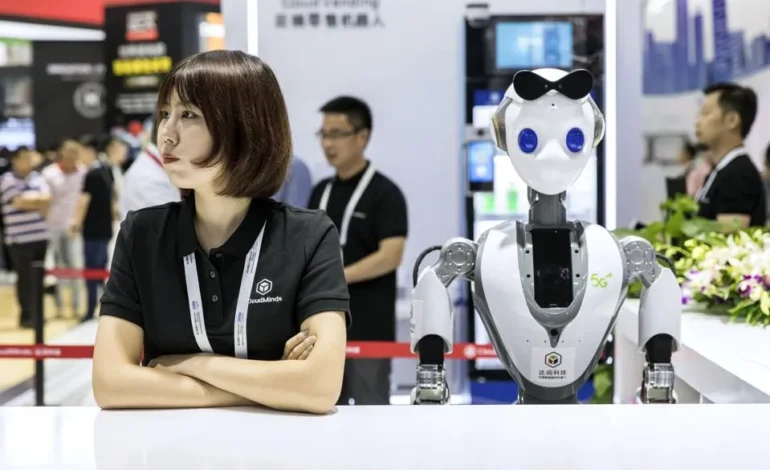
Initially, customers viewed service robots as gimmicks. Today, acceptance has grown rapidly, especially among younger consumers who associate automation with innovation and reliability. Surveys by iResearch show that over 70 percent of Chinese urban shoppers prefer stores that use robots for assistance or delivery. The novelty factor has evolved into trust, with users appreciating the hygiene, speed, and accuracy that robots provide. In luxury retail and hospitality, robots also add an element of technological sophistication to brand identity. The emotional connection between humans and machines is deepening through design—many robots feature expressive faces, polite speech, and personalized greetings that create a sense of friendliness rather than detachment.
Industry Leaders and Market Growth
China’s service robotics market is expanding at an annual rate exceeding 30 percent. Companies like PuduTech dominate the restaurant automation segment with delivery robots serving millions of meals daily across Asia, Europe, and the Middle East. Keenon Robotics focuses on hotel and commercial service systems, while UBTech and OrionStar are developing humanoid robots for retail and education. These companies benefit from strong investment ecosystems in Shenzhen and Shanghai, where government-supported innovation parks foster collaboration between hardware manufacturers, AI developers, and design studios. Global demand for Chinese service robots is also rising as retailers abroad seek cost-effective automation solutions, positioning China as both a supplier and innovator in this emerging industry.
Role of Artificial Intelligence in Personalization
AI personalization is transforming how robots interact with customers. Machine learning algorithms analyze behavior patterns to predict needs and preferences. In large shopping centers, robots can recommend stores or promotions based on visitor demographics and past interactions. In restaurants, they memorize returning customers’ seating choices and food preferences. This data-driven personalization enhances customer satisfaction while generating valuable analytics for retailers. The blending of physical presence and digital intelligence is turning robots into platforms for both service delivery and data collection, a combination that strengthens business intelligence and operational strategy.
Integration with Smart Retail Ecosystems
Service robots are a key component of China’s broader smart retail transformation. They connect with Internet-of-Things sensors, digital payment platforms, and cloud management systems to create seamless operations. Robots automatically update inventory databases when items are sold or delivered, ensuring real-time accuracy. In logistics centers, robotic fleets coordinate through centralized control software that optimizes routes and energy usage. The integration of 5G networks further enhances reliability by reducing latency in command processing. Together, these technologies enable autonomous retail systems capable of operating efficiently with minimal human supervision. This integration is shaping the next generation of unmanned convenience stores and automated shopping malls.
Challenges and Ethical Considerations
Despite their benefits, service robots raise questions about employment, privacy, and safety. Some sectors fear that automation could displace low-income workers, while others argue that it creates new jobs in programming, maintenance, and AI management. Data privacy is another challenge, as robots equipped with cameras and microphones collect sensitive customer information. To address these issues, Chinese regulators have introduced guidelines for AI ethics and data protection in commercial environments. Companies are required to anonymize customer data and obtain consent for its use. Ensuring transparency and accountability will be critical for maintaining public trust as robot deployment increases.
Export Potential and Global Adoption
The appeal of Chinese service robots extends beyond national borders. Countries in Southeast Asia, Europe, and the Middle East are adopting them for hotels, hospitals, and retail chains. The cost advantage of Chinese manufacturing combined with robust AI design makes these products competitive internationally. Trade data from the Ministry of Commerce shows that service robot exports grew by more than 50 percent in 2024, making it one of China’s fastest-growing technology exports. This global expansion reinforces China’s reputation as a leader in applied robotics, complementing its strength in industrial and consumer electronics manufacturing.
Future Prospects for Human-Machine Collaboration
The next phase of retail robotics will focus on collaboration rather than replacement. Future robots will work side by side with humans, handling logistics and information tasks while staff provide empathy and creativity. Advances in emotion recognition and natural communication will make robots better companions in customer service. As sensors become cheaper and algorithms more efficient, service robots will expand into small businesses and public institutions. The retail environments of the future will be defined by human-machine symbiosis where automation enhances productivity without eliminating human presence.
Conclusion
Service robots have become a defining feature of China’s retail transformation. By combining artificial intelligence, automation, and design, they are changing how people shop, dine, and interact. For businesses, they offer efficiency and insight; for consumers, they provide convenience and novelty. The question is no longer whether robots will shape retail but how deeply they will integrate into daily life. As China continues to refine its robotics technology and export expertise, the rest of the world is watching a preview of commerce’s next evolution, one where machines and people share the same customer space with precision, empathy, and intelligence.