Service Robots in Hospitals and Retail

Service robots are transforming operational efficiency and customer experience in hospitals and retail environments. Unlike industrial robots that focus on manufacturing, service robots perform tasks that directly interact with humans, ranging from patient assistance and logistics to customer engagement and inventory management. Chinese enterprises are increasingly adopting these robotic solutions to enhance efficiency, improve service quality, and reduce operational costs. This blog explores trends in service robotics, sector-specific applications, technological innovations, and the impact on hospitals and retail operations.
Hospital Applications of Service Robots
Hospitals deploy service robots to streamline routine operations, reduce staff workload, and enhance patient care. Robots assist in medication delivery, patient monitoring, sanitation, and transportation of medical supplies. Autonomous delivery robots navigate hospital corridors to transport equipment and pharmaceuticals efficiently. Robots equipped with sensors and AI can monitor vital signs, detect patient emergencies, and alert medical staff in real time. These innovations improve operational efficiency, reduce human error, and free healthcare personnel to focus on clinical tasks.
Patient Interaction and Telemedicine
Service robots also enhance patient interaction and support telemedicine services. Robots can facilitate virtual consultations, provide health education, and guide patients through hospital facilities. Telepresence robots enable remote specialists to interact with patients, enhancing access to expert care. By integrating AI and natural language processing, robots can answer queries, collect patient information, and provide reminders for medication or therapy. This reduces wait times and enhances the overall patient experience.
Sanitation and Disinfection
Robotic sanitation systems play a critical role in infection control. Ultraviolet (UV) disinfection robots autonomously clean rooms, operating theaters, and corridors, minimizing the risk of hospital-acquired infections. Automated floor cleaners and air purification systems improve hygiene standards, ensuring a safer environment for patients, staff, and visitors. Deployment of sanitation robots enhances operational efficiency while maintaining high safety standards in healthcare settings.
Retail Applications of Service Robots
In retail, service robots improve customer engagement, inventory management, and operational efficiency. Robots can guide customers, provide product information, and facilitate transactions. Autonomous inventory robots scan shelves, track stock levels, and identify misplaced items, reducing labor costs and improving accuracy. Customer-facing robots enhance shopping experiences by offering personalized recommendations, answering queries, and promoting loyalty programs.
Robotics in E-Commerce and Warehousing
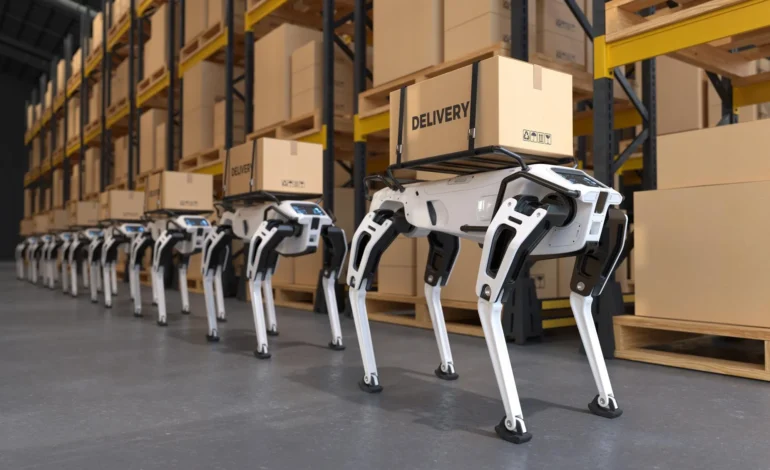
Retail service robots are also integral to e-commerce and warehouse operations. Autonomous mobile robots (AMRs) handle picking, packing, and transportation of goods within warehouses. AI-driven robots optimize routes, manage inventory flow, and ensure timely order fulfillment. These systems improve supply chain efficiency, reduce operational errors, and enable rapid scaling of warehouse operations to meet customer demand.
Technological Innovations
Service robots integrate advanced technologies such as artificial intelligence, computer vision, natural language processing, and autonomous navigation. AI enables robots to learn from interactions, optimize tasks, and adapt to changing environments. Computer vision and sensors support object recognition, obstacle avoidance, and precise movement. Natural language processing allows robots to understand spoken or written commands, enhancing human-robot interaction in both hospitals and retail spaces.
Collaboration with Human Staff
Service robots complement human workers by handling repetitive, time-consuming, or physically demanding tasks. In hospitals, robots transport supplies or assist patients while nurses focus on clinical care. In retail, robots manage inventory checks and customer inquiries, allowing employees to concentrate on sales and customer service. Collaborative operations enhance overall efficiency and enable human staff to engage in higher-value activities.
Challenges in Deployment
Deploying service robots presents challenges, including integration with existing systems, maintenance, cost, and employee adaptation. Hospitals and retail organizations must address navigation in complex environments, interoperability with software platforms, and cybersecurity risks. Training staff to work alongside robots and ensuring patient or customer acceptance are critical for successful adoption. Enterprises implement pilot programs, gradual integration, and continuous monitoring to mitigate these challenges.
Investment and Market Adoption
Investment in service robotics is growing rapidly in China, driven by government incentives, technological advancements, and increasing demand for automation. Hospitals and retail chains allocate capital to purchase, implement, and maintain robotic systems. Startups and technology providers focus on creating scalable, modular, and adaptable robots tailored to healthcare and retail environments. Market adoption continues to expand as enterprises recognize operational and economic benefits.
Impact on Customer and Patient Experience
Service robots improve both patient and customer experiences by enhancing responsiveness, providing accurate information, and maintaining consistent service quality. In hospitals, robots reduce wait times, improve patient engagement, and increase safety. In retail, robots provide instant assistance, personalized recommendations, and seamless shopping experiences. Improved service quality contributes to higher satisfaction, loyalty, and operational efficiency.
Regulatory and Safety Considerations
Service robots must comply with safety standards, data protection regulations, and operational guidelines. Hospitals follow medical device and patient safety regulations, while retail robots adhere to consumer safety and privacy requirements. Risk assessment, collision avoidance systems, and fail-safe mechanisms ensure safe human-robot interaction. Regulatory compliance enhances public trust and supports widespread adoption.
Future Potential
Service robotics in hospitals and retail is expected to expand further with advances in AI, autonomous navigation, human-robot interaction, and connectivity. Integration with smart infrastructure, IoT devices, and data analytics will enable more intelligent, adaptive, and personalized service delivery. Enterprises that leverage service robots strategically can improve efficiency, enhance experience, and maintain competitiveness in increasingly automated environments.
Conclusion
Service robots are transforming hospitals and retail environments by automating routine tasks, improving operational efficiency, and enhancing user experience. Technological innovations in AI, computer vision, and autonomous navigation enable robots to assist staff, engage customers, and deliver high-quality services. Despite challenges in deployment, cost, and integration, adoption continues to grow across China. Service robotics represents a critical tool for improving healthcare delivery, retail operations, and organizational efficiency while creating scalable solutions for the future of human-robot collaboration.