Shenzhen’s Industrial Robots: The Backbone of China’s Manufacturing Upgrade
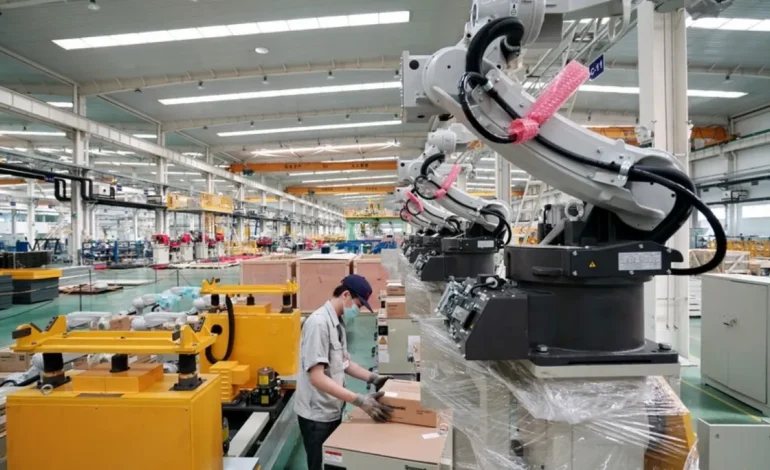
China’s industrial transformation is increasingly defined by automation, and nowhere is this clearer than in Shenzhen. Once known primarily as the hub of global electronics assembly, the city has evolved into a testbed for advanced robotics and smart manufacturing. Industrial robots now form the backbone of production across automotive, electronics, and logistics sectors, improving efficiency, reducing labor costs, and ensuring supply chain resilience. According to Xinhua, Caixin, and TechNode, China’s industrial robot installations surpassed 430,000 units in 2024, accounting for more than half of global demand. Shenzhen, with its dense ecosystem of tech firms and factories, leads this revolution, proving that robotics is no longer a luxury for high-end production but a necessity for national competitiveness.
China’s Strategic Pivot Toward Industrial Automation
China’s manufacturing sector, which contributes nearly 27% of national GDP, has faced rising labor costs and international pressure to move up the value chain. The government’s Made in China 2025 initiative identified robotics as a core strategic industry, targeting domestic robot density to reach 400 units per 10,000 workers by 2025. Shenzhen, Suzhou, and Guangzhou have become focal points of this transformation.
The Shenzhen Municipal Government launched the Smart Manufacturing Action Plan to subsidize automation for small and medium enterprises. Companies can receive up to 30% reimbursement on robot deployment costs. As a result, over 70% of Shenzhen’s manufacturing firms now use industrial robots in at least one stage of production.
The benefits extend beyond labor savings. Smart robotics systems improve precision, reduce waste, and enhance product consistency. Foxconn, which employs hundreds of thousands of workers across China, has automated major assembly lines for smartphones and components using robots developed in collaboration with Huawei’s Atlas AI computing platform. The result is a 20% increase in output efficiency and a reduction in defective units.
Shenzhen’s Robotics Ecosystem: Innovation in Motion
The city’s robotics ecosystem is built on strong collaboration between startups, universities, and global manufacturers. Local firms such as Siasun, Efort, and Estun have emerged as key suppliers of industrial robots for welding, assembly, and packaging. Shenzhen Institute of Advanced Technology (SIAT) serves as the research hub, linking industry demand with academic innovation.
TechNode reports that over 600 robotics companies now operate in Shenzhen’s Pingshan and Bao’an districts, forming one of the world’s densest automation clusters. These companies specialize in sensors, actuators, and machine vision systems that allow robots to adapt to complex environments. The use of AI has taken robotics beyond fixed, repetitive motions. Machines now detect defects autonomously, optimize their own movements, and learn from production data.
Huawei’s “FusionPlant” digital platform connects robots, production lines, and supply chain data through industrial 5G networks. This cloud-based system allows managers to monitor entire factories in real time, improving transparency and response time. Meanwhile, Tencent Cloud has introduced simulation tools that create “digital twins” of factories, letting engineers test process changes virtually before applying them on the floor.
Shenzhen’s start-ups are also gaining traction abroad. Agile Robots, a local firm combining German engineering with Chinese AI, recently raised $200 million to expand into Europe. The company’s lightweight robots are already used in BMW assembly plants, showing that China’s automation expertise is now globally competitive.
AI-Driven Productivity and Workforce Transformation
The adoption of industrial robots is not replacing human labor entirely but transforming it. Workers are being retrained to manage and maintain automated systems, moving from repetitive manual tasks to supervisory and analytical roles. According to Caixin, Shenzhen’s local government has funded vocational training centers focused on robotics operation and maintenance, producing 50,000 skilled technicians annually.
AI-powered robotics also play a critical role in quality control and customization. Machine learning algorithms detect deviations at the microsecond level, adjusting robotic arms to maintain uniformity. This capability has become vital for high-precision industries such as semiconductor packaging and medical device manufacturing.
At DJI’s drone production facility, over 1,000 collaborative robots (cobots) work alongside human technicians to assemble and inspect drones. These robots identify alignment issues and make corrections within milliseconds, reducing defect rates by 30%. The human-robot collaboration model is now a hallmark of Shenzhen’s advanced manufacturing identity.
The integration of robotics has also boosted export performance. Shenzhen’s industrial equipment exports grew 18% year-on-year in 2025, reaching $45 billion. Chinese-made robots are now being exported to Southeast Asia, Eastern Europe, and South America, where cost-effective automation is in demand.
Sustainability and Smart Manufacturing Efficiency
Automation is also improving China’s environmental performance. Industrial robots help reduce material waste and energy consumption by optimizing manufacturing cycles. The National Development and Reform Commission (NDRC) estimates that robot-assisted production has cut energy use per unit of industrial output by 8% since 2020.
Factories equipped with robotic systems can adjust energy usage dynamically, powering down idle machines during low-load periods. BYD’s electric vehicle plants in Shenzhen are fully automated, from body welding to battery module assembly. The combination of robotics and renewable energy integration has made the facility one of China’s most efficient and low-carbon manufacturing sites.
Meanwhile, recycling automation is gaining attention. Robotic arms are used to sort electronic waste and recover valuable materials with precision far exceeding human capability. This circular manufacturing approach aligns with China’s broader “dual-carbon” strategy to peak emissions before 2030 and achieve neutrality by 2060.
Challenges
While Shenzhen’s robotics revolution is progressing rapidly, it faces challenges in high-end component manufacturing. Core technologies such as precision reducers, servo motors, and control chips are still partially dependent on imports from Japan and Germany. The government’s response is to boost domestic R&D through the National Robotics Innovation Fund, which allocates 50 billion yuan for component self-reliance by 2027.
Another challenge is integration standardization. Many factories use robots from different vendors, leading to software compatibility issues. Industry bodies are now developing open-source control platforms to unify protocols and reduce deployment costs.
The global economic slowdown also poses short-term risks, but long-term prospects remain strong. With rising demand for automation in logistics, healthcare, and consumer electronics, analysts expect China’s robotics market to exceed 350 billion yuan by 2026.
Conclusion
Shenzhen’s industrial robots embody China’s manufacturing evolution from labor-intensive production to intelligent automation. The city’s factories, once symbols of low-cost output, are now showcases of digital precision and innovation.
By combining AI, 5G connectivity, and advanced robotics, China is building a manufacturing ecosystem that can sustain global competitiveness and environmental responsibility. The transformation underway in Shenzhen reflects a broader truth about China’s industrial future progress will be driven not just by scale, but by intelligence, adaptability, and relentless technological ambition.