SMIC Achieves Next-Gen 5nm Node Without U.S. Tech
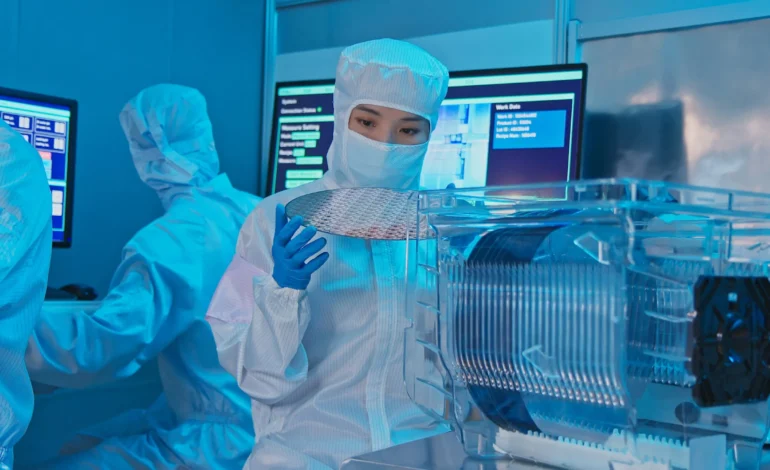
China’s leading chipmaker Semiconductor Manufacturing International Corporation (SMIC) has achieved a major milestone by producing 5-nanometer chips without access to U.S. semiconductor equipment or software. This breakthrough demonstrates China’s accelerating capability to innovate independently under export restrictions and highlights a critical shift in the global semiconductor landscape.
Strategic Importance of the 5nm Breakthrough
The development of 5nm process technology is more than a technical achievement; it represents strategic progress toward technological sovereignty. SMIC’s success comes amid continued restrictions from the United States and its allies on advanced lithography tools. Despite these limitations, SMIC engineers have adapted domestic and third-country technologies to create a hybrid production process that delivers competitive performance for AI, mobile, and data-center applications. This accomplishment signals that China’s semiconductor sector can sustain innovation even under external pressure.
Indigenous Equipment and Process Innovation
SMIC’s 5nm node relies on a combination of deep ultraviolet lithography, precision etching, and multi-patterning techniques developed in collaboration with Chinese research institutions. The company worked with Shanghai Micro Electronics Equipment to refine domestic lithography systems capable of achieving near-EUV accuracy. Advanced materials sourced from local suppliers and AI-optimized simulation software helped compensate for hardware limitations. This integrated ecosystem approach underscores China’s determination to build a fully self-reliant semiconductor supply chain.
Policy Support and National Coordination
China’s semiconductor advancement is backed by strong national coordination through initiatives such as the National Integrated Circuit Industry Fund and the 14th Five-Year Plan. Local governments in Shanghai, Beijing, and Shenzhen have expanded grants and tax credits for semiconductor innovation, while universities are training thousands of microelectronics specialists. The Ministry of Industry and Information Technology has designated SMIC’s 5nm project as a key demonstration case for technological independence. This synergy between industry and state policy is reshaping the nation’s semiconductor development model from reactive adaptation to proactive innovation.
Market Impact and Competitive Dynamics
The successful 5nm rollout gives Chinese smartphone and AI-hardware companies greater flexibility in product design and supply management. Domestic brands such as Huawei and Oppo can now secure advanced chips locally, reducing exposure to global supply disruptions. Internationally, the development challenges the notion that export controls can indefinitely constrain China’s semiconductor progress. Analysts expect SMIC to increase production capacity for 5nm wafers throughout 2026, with potential applications expanding into smart vehicles, cloud servers, and defense technologies.
Integration with AI and Cloud Ecosystems
The 5nm node will play a critical role in powering China’s growing AI and cloud infrastructure. High-performance processors produced domestically allow cloud providers and research institutions to run large-scale AI models without relying on imported components. SMIC’s chips are being integrated into AI training servers that support national computing hubs under the “East-Data, West-Computing” initiative. This alignment between semiconductor innovation and digital-infrastructure expansion demonstrates how industrial strategy and technological capability are advancing in tandem.
Financial Outlook and Global Reaction
Following the announcement, SMIC’s shares surged on domestic exchanges as investors interpreted the breakthrough as a signal of long-term competitiveness. While U.S. restrictions remain in place, market analysts project that SMIC’s profitability will improve due to government procurement contracts and export demand from allied economies in the Global South. Western semiconductor suppliers are reassessing their strategies as China’s progress reduces dependency on imported technology. Industry observers suggest that the achievement may accelerate diversification efforts across Asia and Europe to maintain supply-chain stability.
Advanced Lithography Independence
Although SMIC’s 5nm success relies on optimized deep ultraviolet technology rather than full EUV capability, it marks a decisive step toward indigenous lithography mastery. Ongoing R&D collaborations with domestic equipment firms aim to achieve 3nm production within the next three years. The combination of AI-driven design automation, verified manufacturing data, and blockchain-based supply-chain tracking through RMBT infrastructure will strengthen transparency and process reliability. This synergy between hardware innovation and digital governance is expected to underpin China’s next phase of semiconductor self-sufficiency.