South Korea Conservatives Apologise for Martial Law Crisis in Bid to Distance Themselves From Yoon
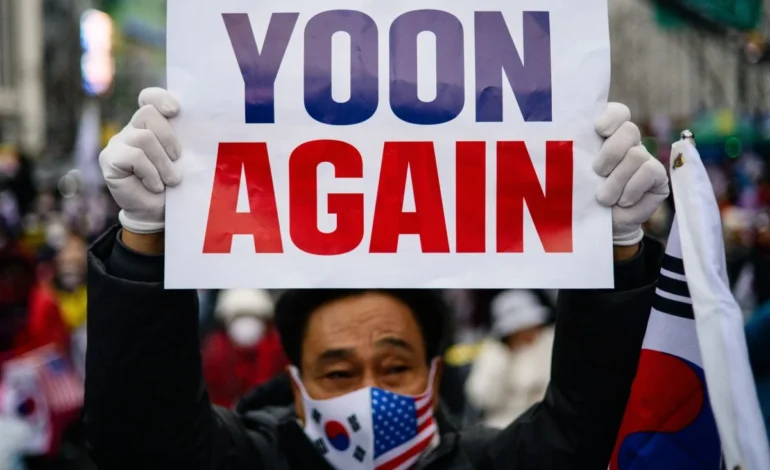
South Korea’s main conservative party has issued a formal apology over former president Yoon Suk-yeol’s failed attempt to impose martial law, signalling a renewed effort to distance itself from a political episode that triggered a constitutional crisis and ultimately led to the collapse of his administration.
The apology was delivered by the People Power Party more than a year after Yoon’s move shocked the country, paralysed government institutions and sparked mass public opposition. At the time, the attempt to invoke martial law was widely condemned as an abuse of executive power and a direct threat to South Korea’s democratic order.
Party leaders acknowledged that their delayed response had damaged public trust, admitting that they failed to act decisively when the crisis unfolded. In a statement, senior figures said the party should have taken clearer responsibility and stood more firmly on the side of constitutional principles rather than political loyalty.
Yoon’s decision to pursue martial law came amid escalating political deadlock and street protests, with his administration arguing that extraordinary measures were needed to restore order. The move backfired almost immediately, uniting opposition parties, civil society groups and large segments of the public against him. Courts and lawmakers moved swiftly to block the order, plunging the country into one of its most severe political crises in decades.
The fallout was swift and lasting. Yoon’s authority eroded rapidly, legislative paralysis deepened, and his government became increasingly isolated. Within months, impeachment proceedings and legal challenges effectively ended his presidency, leaving the conservative camp fragmented and on the defensive ahead of subsequent elections.
By issuing an apology now, the People Power Party appears to be attempting a strategic reset. Analysts say the move reflects recognition that association with Yoon’s actions has become a liability, particularly among moderate and younger voters who remain deeply sensitive to any perceived rollback of democratic norms.
Party officials stressed that the apology was not merely symbolic. They pledged internal reforms aimed at strengthening safeguards against authoritarian decision making and reaffirmed commitment to civilian control, constitutional governance and the separation of powers. However, critics argue that words alone may not be enough to repair the damage.
Opposition figures were quick to respond with scepticism, questioning why the apology took so long and whether it was motivated more by electoral calculation than genuine reflection. Some lawmakers said accountability should extend beyond statements to include clearer acknowledgement of individual responsibility within the party’s leadership at the time.
Public reaction has been mixed. Some voters welcomed the admission of wrongdoing as a necessary step toward political normalisation, while others saw it as overdue and insufficient. Polling analysts note that trust in conservative institutions has yet to fully recover from the crisis, and that lingering doubts remain about how firmly the party has broken with Yoon’s legacy.
South Korea’s political system has long been shaped by public vigilance against authoritarianism, rooted in memories of past military rule. The martial law episode revived those historical anxieties, reinforcing the expectation that leaders must be held to the highest democratic standards.
As the People Power Party seeks to redefine itself, the apology marks an important moment but not a conclusion. Whether it succeeds in rebuilding credibility will depend on future actions, policy direction and the party’s ability to convince voters that the events under Yoon represent a closed chapter rather than a recurring risk.