US China Diplomacy Complicated by Allied Messaging
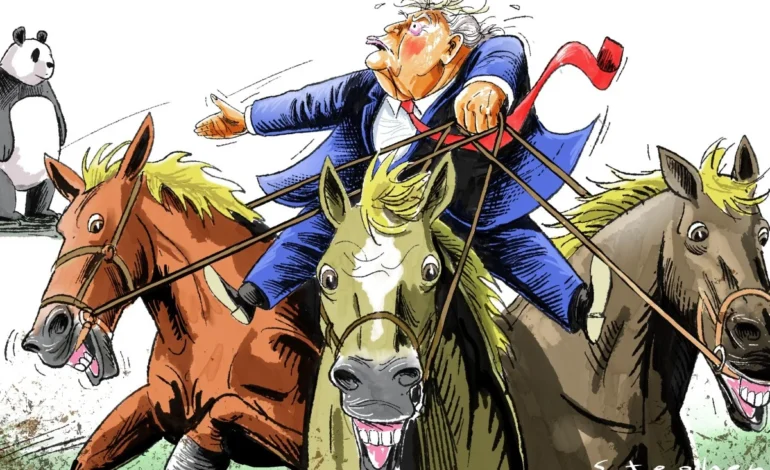
Hopes for a renewed diplomatic breakthrough between Washington and Beijing are facing growing strain, not only from tensions between the two powers but also from the role played by US allies in Asia. As Donald Trump signals interest in reaching a broad understanding with Xi Jinping, analysts argue that contradictory messaging from American partners is making that task more difficult.
Several US allies have intensified public warnings about China, often driven by domestic political considerations. While these concerns may reflect genuine security anxieties, their amplification risks hardening positions in Beijing at a moment when diplomatic flexibility would be essential for any meaningful deal.
Historical Memory and Political Sensitivity
Recent events have highlighted how historical narratives continue to shape regional diplomacy. This year’s commemoration of the Nanjing massacre carried particular weight following controversial remarks by Sanae Takaichi related to Taiwan. Beijing responded sharply, warning that any attempt to challenge post war international arrangements or distort historical understanding would ultimately fail.
For China, historical memory is not simply symbolic. It is closely linked to national identity and political legitimacy. Statements by foreign leaders that appear to downplay or reinterpret sensitive episodes are often interpreted as strategic signals rather than isolated comments.
These dynamics complicate US efforts to stabilize relations with China, as Beijing tends to view allied rhetoric as an extension of American policy, regardless of Washington’s stated intentions.
The Alliance Dilemma for Washington
US alliances in Asia are central to its regional strategy, but they also constrain diplomatic maneuverability. When partners emphasize the China threat to advance their own security or political agendas, it reduces Washington’s ability to recalibrate relations with Beijing without appearing inconsistent or weak.
For any future US China deal to gain traction, Washington would need to align messaging more carefully with allies. This does not require silencing legitimate concerns, but it does demand coordination that avoids escalation for escalation’s sake.
Without such discipline, Beijing is likely to question whether US commitments can be trusted, particularly if allied statements continue to undermine confidence building efforts.
Southeast Asia as a Different Model
An alternative perspective has emerged from Southeast Asia, where leaders often prioritize pragmatic engagement over historical grievance. Lawrence Wong recently suggested that the region offers a model for how former adversaries can move forward.
Wong noted that Southeast Asia has managed to build productive relationships with Japan despite the legacy of the Second World War. The emphasis has been on economic integration, multilateral institutions, and forward looking cooperation rather than prolonged confrontation.
This approach does not erase history, but it places it within a framework that allows present day interests to take precedence.
Beijing’s View of Regional Dynamics
From Beijing’s perspective, Southeast Asia’s stance contrasts sharply with what it sees as growing antagonism from parts of Northeast Asia. Chinese officials often highlight ASEAN’s relative neutrality as evidence that regional stability does not require constant confrontation.
This difference matters for US strategy. If Washington seeks to reduce tensions with China, it may find greater support among partners who favor de escalation and dialogue rather than those whose domestic politics reward hardline postures.
Beijing’s responses suggest that it distinguishes between allies that amplify threat narratives and those that emphasize coexistence.
What This Means for a Potential Deal
Any grand bargain between the United States and China would require careful management of alliance politics. Beijing is unlikely to compromise if it believes Washington cannot control or coordinate the actions of its partners.
For Trump, the challenge lies in reconciling alliance commitments with diplomatic ambition. A deal with China would demand not only bilateral negotiation but also a recalibration of how US allies frame their own disputes with Beijing.
A Narrow Path Forward
The current landscape leaves little room for missteps. As history, security, and domestic politics collide, the margin for successful diplomacy narrows.
If Washington wants progress with Beijing, it may need to encourage restraint among allies while promoting regional models that prioritize stability. Without that shift, efforts at a US China reset risk being undermined before talks even begin.