US Government Shutdown Casts Shadow Over China Trade Talks as Agricultural Officials Miss Shanghai Expo
Reading Time: 4 minutes
The ongoing U.S. federal government shutdown has reached far beyond the halls of Washington, dealing an unexpected blow to bilateral trade engagement with China just as diplomatic relations appeared to be stabilizing. The disruption has prevented U.S. agricultural officials from participating in the China International Import Expo (CIIE) in Shanghai, marking a significant absence at one of the world’s most prominent trade exhibitions.
Officials from the U.S. Department of Agriculture (USDA) were notably absent from this year’s expo, held annually to showcase global products and foster international trade cooperation. According to individuals familiar with the matter, the absence was directly tied to the record-breaking government shutdown, which has paralyzed routine federal operations and international engagement.
This year’s no-show by the USDA represents the first time the agency has missed the event since the American Food and Agriculture Pavilion was first introduced at the CIIE in 2023. The pavilion had previously served as a high-profile platform to promote American agricultural goods—particularly soybeans, beef, and dairy products—to Chinese buyers and policymakers.
“Had it not been for the federal government shutdown, they would already have been here at the CIIE, now that President Trump has met President Xi and China has resumed buying,” said a source close to the U.S. agricultural delegation, who spoke on condition of anonymity.
The missed opportunity comes at a particularly delicate moment in U.S.-China trade relations. Just weeks earlier, Presidents Donald Trump and Xi Jinping held a closely watched summit aimed at renewing diplomatic and economic cooperation. As part of the outcomes from that meeting, China had signaled a willingness to resume purchases of certain U.S. agricultural products, a gesture seen as a goodwill move amid years of tariff battles and political tension.
Agricultural trade remains one of the few areas of mutual benefit and potential consensus between the two global powers. U.S. farmers have long viewed China as a crucial export market, particularly for soybeans and grains. Conversely, China continues to rely on American agricultural imports to help ensure food security and stabilize domestic food prices.
Analysts warn that the absence of USDA officials at the expo may hamper efforts to translate the recent diplomatic thaw into tangible commercial outcomes. “Face-to-face engagement is a cornerstone of agricultural trade deals,” said a Shanghai-based trade consultant. “Without federal representation at this level, you lose not only visibility but also the chance to address regulatory, safety, and logistics concerns that often need government-to-government coordination.”
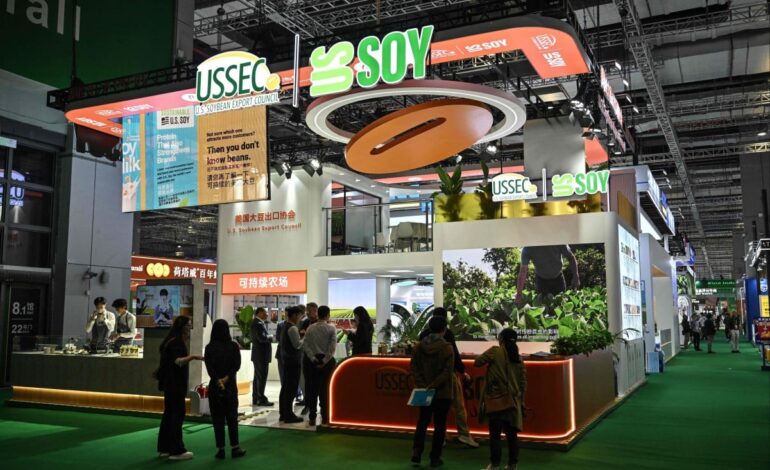
In the USDA’s absence, U.S.-based industry groups such as the U.S. Soybean Export Council maintained a presence at the CIIE. However, private-sector representatives often lack the authority or access that government officials can provide during bilateral negotiations or protocol discussions.
The incident also illustrates how domestic U.S. political dysfunction can have unintended international consequences. The federal government shutdown—triggered by funding gridlock in Congress—has not only delayed public services and impacted federal employees, but it is also beginning to strain the credibility and reliability of U.S. representation in strategic economic forums.
China’s leadership, which has prioritized stability and predictable trade engagement, is likely to view the absence as a setback, even if temporary. “This was a moment to build on diplomatic momentum,” said a Hong Kong-based economist. “Now it feels like that momentum may stall.”
As of now, there is no formal timeline for the USDA’s resumption of full international activity, as the federal budget impasse in Washington continues with no immediate resolution in sight. Whether the missed engagement at CIIE will materially impact agricultural trade volumes remains to be seen, but the symbolic loss of presence at a crucial moment in U.S.-China diplomacy is already clear.