
What Viral Images Reveal About China’s Civilian to Military Shipping Strategy
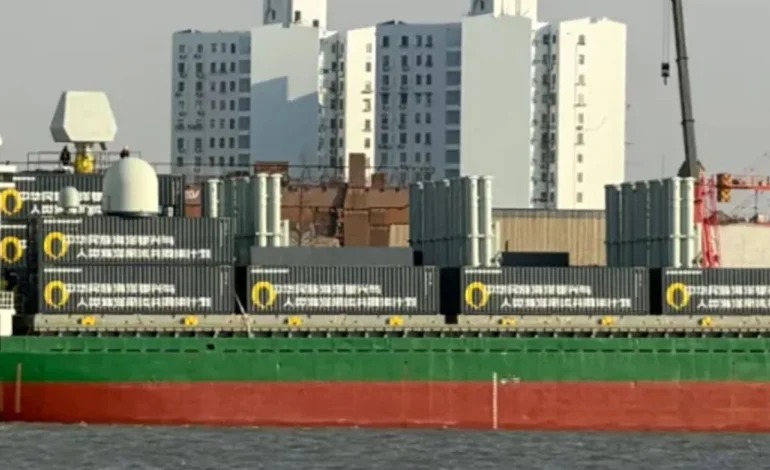
Images That Sparked Global Speculation
A series of images circulating online has triggered intense debate over whether China is quietly preparing its civilian shipping fleet for potential military use. The photos, reportedly taken in Shanghai, show a large cargo vessel fitted with containerized military equipment, including vertical launch systems, radar arrays, and close range defensive weapons. The unusual configuration has prompted analysts and observers to question whether the ship represents a test case for converting commercial vessels into armed platforms during wartime.
While no official explanation has been provided, the visual evidence alone has been enough to raise eyebrows across defense and maritime communities.
What the Images Appear to Show
The circulated photographs depict what looks like standard shipping containers placed on the deck of a cargo ship. Unlike ordinary containers, however, these units appear to house military hardware. Observers have identified containerized vertical launch systems, rotary phased array radars, over the horizon radar units, close in weapon systems, and decoy launchers.
The equipment appears modular and self contained, suggesting it could be installed and removed without permanently altering the ship’s structure. This has led to speculation that the setup is designed for rapid conversion rather than long term deployment.
Temporary Configuration With Strategic Purpose
Most analysts agree that the installation appears temporary. The systems are mounted on containers rather than integrated into the hull, indicating a flexible design. This approach would allow civilian vessels to be converted quickly into auxiliary military assets and later returned to commercial service.
Such adaptability aligns with modern concepts of dual use infrastructure, where civilian platforms are designed to support military needs in emergencies. In this case, a merchant ship could potentially function as a missile platform, surveillance node, or escort vessel if required.
Civilian Shipping and Military Doctrine
The idea of using civilian ships for military purposes is not new. Many countries maintain auxiliary fleets that can be mobilized during conflict. What makes this case notable is the apparent level of armament and sensor integration visible in the images.
China has long emphasized civil military integration as part of its broader national strategy. This policy encourages closer coordination between civilian industries and defense requirements, including logistics, transport, and technology development.
Strategic Advantages of Containerized Weapons
Containerized weapon systems offer several advantages. They can be disguised as ordinary cargo, transported discreetly, and deployed with minimal preparation. In a conflict scenario, this could complicate an adversary’s ability to distinguish between civilian and military targets.
Such ambiguity raises both strategic and legal questions. While the approach could enhance flexibility and deterrence, it also risks blurring the line between civilian and combatant assets, increasing the danger to commercial shipping during hostilities.
Signals to Regional Rivals
The appearance of these images may also serve a signaling function. Demonstrating the ability to rapidly militarize civilian vessels sends a message about depth and resilience in maritime capability. Even if the ship is part of a test or exercise, the implication is that China could expand its naval footprint beyond traditional warships in a crisis.
This is particularly relevant in regions where maritime dominance and sea lane control are critical strategic concerns.
Lack of Official Confirmation
So far, Chinese authorities have not confirmed the purpose of the vessel or the nature of the equipment seen in the images. Without official statements, it remains unclear whether the ship was part of an experiment, a technology demonstration, or a routine test unrelated to operational planning.
The absence of confirmation leaves room for speculation but also caution. Visual evidence alone cannot fully explain intent, doctrine, or readiness.
What This Means Going Forward
If the images do reflect genuine experimentation with civilian to military conversion, it would highlight a growing trend toward modular and flexible warfare capabilities. Modern conflicts increasingly value adaptability, rapid deployment, and the ability to leverage existing infrastructure.
At the same time, the development raises concerns about escalation and miscalculation. As civilian vessels become harder to distinguish from military ones, the risks to global shipping and maritime stability could increase.
A Question That Will Not Fade Easily
Whether these images represent a quiet rehearsal or a misunderstood test, they have opened an important discussion about the future of naval warfare. The idea that cargo ships could swiftly transform into armed vessels challenges traditional assumptions about fleet size and force projection.
For now, the question remains unanswered. But the images have already achieved something significant by drawing attention to how modern militaries may be rethinking the boundary between civilian assets and combat power.



