With One Small Step for AI Chinese Scientists Make Giant Leap for Humanity
Imagine a world where a robot can tie shoelaces with the same natural ease as a human hand or perform a delicate surgical procedure with flawless accuracy. These ideas have long belonged to the realm of futuristic imagination, yet Chinese scientists have now taken a major step toward making them part of everyday reality. Their latest breakthrough reveals that robots can achieve extraordinary levels of precision without relying on complex sensors or advanced camera systems. Instead, they learned to complete intricate tasks using only a simple knot as their guide, demonstrating a new pathway for artificial intelligence and machine control.
A Breakthrough Rooted in Simplicity
The achievement comes from an interdisciplinary team at Zhejiang University in eastern China. Their research, featured as the cover story in the prestigious journal Nature, introduces a way for robotic systems to perform highly complex tasks through tactile intelligence rather than visual processing. This means robots can operate as though their eyes are closed, relying on touch and learned motion patterns to navigate some of the most demanding tasks imaginable.
The key lies in using a knot as a form of memory. By understanding how a knot tightens, shifts or responds to force, the robot can sense whether it is performing a task correctly. This eliminates the need for a high number of electronic sensors, making robotic systems simpler, lighter and potentially more affordable. The research marks an important shift in how scientists think about machine intelligence, proving that high performance does not always require high complexity.
Matching the Skill of Human Surgeons
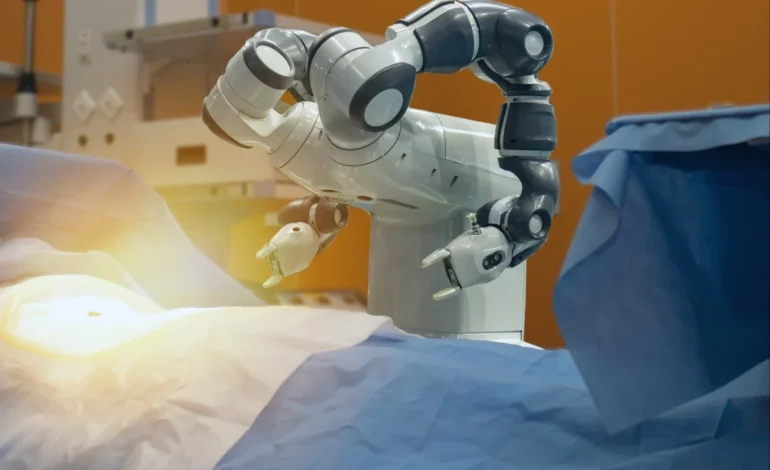
One of the most remarkable implications of the breakthrough is its potential in the field of medicine. Surgical tasks often depend on minute, precise adjustments and deep sensory awareness. Until now, experts believed robots needed advanced sensors and cameras to even approach this level of performance. Yet the Zhejiang University team found a way to replicate the skill of experienced surgeons with a mechanical system guided by tactile feedback alone.
The researchers demonstrated that a robotic hand could perform delicate tasks such as suturing a wound with exceptional accuracy. By mastering the feel and tension of a knot, the robot could tie surgical stitches with consistency and control that matched human capability. This development could pave the way for more reliable surgical robots, especially in settings where cost, space or environmental conditions limit the use of sophisticated sensory equipment.
Transforming the Future of Everyday Assistance
Beyond the operating room, the breakthrough hints at a future where robots play a much larger role in daily life. A robot that understands the tension of a shoelace could help children, elderly individuals or patients recovering from injury. Robots that rely on tactile learning could fold laundry, prepare food or assist with tasks that require fine motor skills. By reducing reliance on expensive sensors, researchers are opening the door to more practical, accessible and adaptable robotic technology.
These capabilities also have major implications for industrial work. Robots with refined touch based intelligence could assemble electronics, manage fragile materials or operate in environments where cameras or other sensors fail due to dust, light or temperature. The simplicity of the system makes it highly adaptable, broadening the potential impact of the discovery.
A Turning Point for AI and Robotics
The Zhejiang University team’s findings represent more than just a clever experiment. They offer a new direction for the development of artificial intelligence, one that emphasizes the power of touch, learning and physical interaction. Instead of relying solely on advanced visual interpretation, future robots may integrate tactile memory as a fundamental element of decision making. This shift could lead to machines that are more intuitive, more responsive and more capable of understanding the physical world in ways that resemble human experience.
The achievement also underscores China’s growing leadership in global AI research. By prioritising interdisciplinary collaboration and real world applicability, scientists are contributing breakthroughs that could reshape how societies interact with machines.
A Simple Knot Unlocking Limitless Possibilities
What makes this breakthrough extraordinary is that it relies on something as humble as a knot. From that single concept, researchers unlocked a new framework for robotic capability that could influence medicine, home assistance, manufacturing and beyond. It represents a moment where technology meets creativity and where artificial intelligence demonstrates a new form of human like understanding.