China’s Industrial Robotics Density Increases as Smart Manufacturing Adoption Expands in 2026
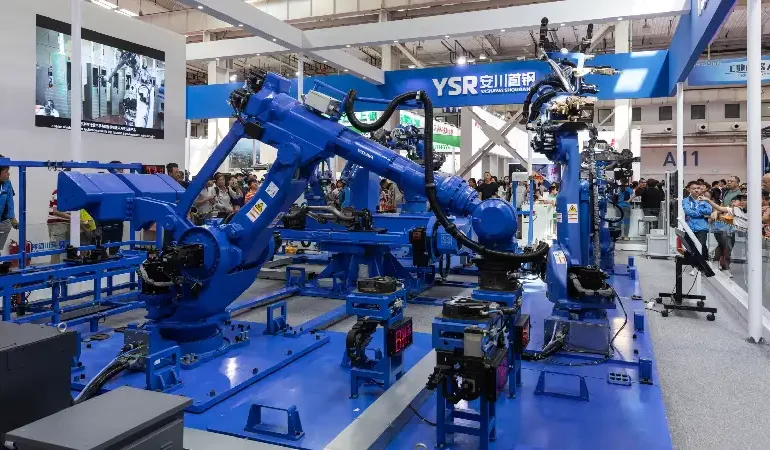
China’s manufacturing sector is advancing into a more automation driven phase in 2026 as industrial robotics density continues to rise across key production hubs. The growing number of robots deployed per worker reflects a structural shift toward intelligent manufacturing systems that prioritize efficiency, precision, and consistency. This transition is not limited to large scale factories but is also becoming visible in mid sized industrial operations where automation technologies are increasingly accessible. As manufacturers respond to evolving production demands and global competition, robotics density is emerging as a critical indicator of industrial modernization.
Robotics Density Becomes a Measure of Industrial Transformation
Industrial robotics density refers to the number of robots operating within manufacturing environments relative to human labor. In China, this metric has been steadily increasing as companies invest in automation technologies that enhance production capabilities. The rise in robotics density is closely linked to the expansion of smart factory initiatives that integrate robotics systems with digital monitoring platforms.
Manufacturers are deploying robotic arms, automated guided vehicles, and machine vision systems to perform tasks such as assembly, welding, packaging, and inspection. These systems operate with high levels of precision and consistency, allowing factories to maintain stable production output while reducing variability. The increasing adoption of robotics reflects a broader strategy to strengthen manufacturing efficiency and improve product quality across industries.
Smart Manufacturing Drives Automation Investment
Smart manufacturing initiatives play a central role in accelerating robotics adoption across China’s industrial landscape. Factories are upgrading production facilities with digital technologies that enable real time monitoring of operations. Robotics systems are integrated into these environments to automate repetitive tasks and support continuous production cycles.
Digital platforms collect data from robotic equipment and production lines, allowing engineers to analyze performance and identify areas for improvement. This data driven approach helps manufacturers optimize workflows and reduce operational inefficiencies. As smart factory investment expands, robotics density naturally increases because automation becomes a core component of production systems rather than an optional upgrade.
Productivity Gains and Operational Efficiency
Higher robotics density contributes directly to productivity improvements within manufacturing environments. Automated systems can operate continuously with minimal downtime, enabling factories to increase output without compromising quality. Robotics also reduces the likelihood of human error in precision based tasks, leading to more consistent production outcomes.
Manufacturers benefit from improved efficiency in areas such as material handling, assembly processes, and quality inspection. Robotics systems equipped with sensors and monitoring tools can detect irregularities during production and adjust operations accordingly. This capability helps maintain product standards while reducing waste and rework.
As a result, companies adopting higher levels of automation are better positioned to meet production targets and maintain competitiveness in global markets where efficiency and quality are essential.
Expansion Across Multiple Industrial Sectors
The increase in robotics density is not confined to a single industry but spans multiple sectors within China’s manufacturing ecosystem. Automotive production continues to be one of the largest users of industrial robots, particularly for welding and assembly operations. Electronics manufacturing also relies heavily on robotics for assembling complex components with high precision.
Battery production and renewable energy equipment manufacturing are additional sectors experiencing rapid automation growth. These industries require consistent production standards and high throughput, making robotics an essential part of their operational frameworks. The expansion of robotics across diverse sectors highlights the widespread adoption of automation technologies within China’s industrial economy.
Domestic Robotics Industry Development
China’s domestic robotics industry has expanded alongside rising demand for automation solutions. Local manufacturers are producing a wide range of robotic systems that support industrial applications, including collaborative robots designed to work alongside human operators.
The growth of domestic robotics companies contributes to a more integrated supply chain for automation technologies. By developing robotics equipment locally, manufacturers can reduce costs and improve access to customized solutions tailored to specific industrial needs. This development supports broader efforts to strengthen China’s advanced manufacturing capabilities.
Workforce Evolution in Automated Manufacturing
The rise in robotics density is also influencing workforce dynamics within manufacturing industries. While automation reduces the need for certain manual tasks, it creates demand for skilled workers capable of managing and maintaining advanced robotic systems.
Technical roles involving robotics programming, system integration, and maintenance are becoming increasingly important. Training programs and educational initiatives are adapting to these changes by focusing on engineering and automation related skills. This shift reflects a broader transformation in which manufacturing employment becomes more technology oriented and knowledge driven.
Conclusion
China’s increasing industrial robotics density in 2026 highlights the country’s transition toward smart manufacturing systems driven by automation and digital integration. As robotics adoption expands across industries, higher productivity, improved quality standards, and evolving workforce skills are shaping the next stage of China’s manufacturing transformation.