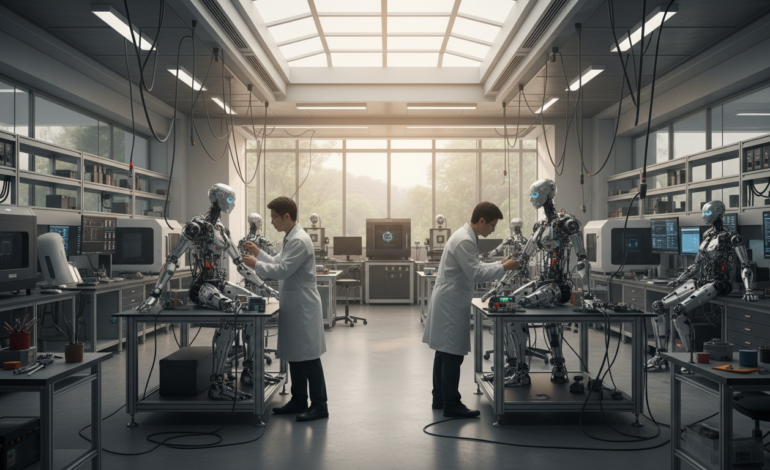
CUHK launches humanoid AI lab to build lifelike robots
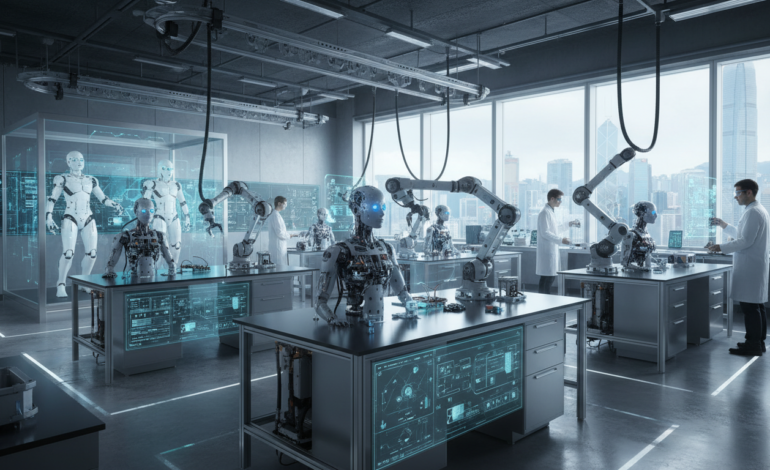
CUHK Collaborates with Tech Firms
CUHK has moved to formalise new industry partnerships as its engineering teams expand hands on testing capacity for embodied intelligence. In briefings Today, university representatives described an AI lab model designed to share datasets, components, and evaluation protocols with corporate partners, naming collaboration as the fastest route to dependable field trials. The work targets humanoid robotics in settings where perception and motor control must be verified under safety constraints and repeatable benchmarks. Live project coordination has focused on aligning supplier lead times with semester schedules so prototypes do not stall mid build. An Update circulated to participating teams set common requirements for on site demonstrations and documentation standards.
Goals of the New Robotics Lab
Leaders of the CUHK initiative framed the lab as an execution unit that can turn academic results into systems that walk, grasp, and interact under supervision. A central goal is to define evaluation gates for humanoid robotics, including energy use, balance recovery, and safe force limits, so experiments translate into measurable performance outcomes. For readers tracking regional business signals, a related market context appears in China April Exports Surge, Surplus Widens Further, which shows how planning cycles respond to demand shifts. Today, administrators also said the AI lab will prioritise reproducible testing and compliance documentation rather than one off demos. Live scheduling tools are being used to manage lab access, while an Update log will track hardware revisions.
Technological Innovations at CUHK
CUHK researchers are emphasising engineering choices that reduce integration friction between sensing, control, and on device inference. Teams described, in Today brief notes, a push toward modular actuator stacks and calibration routines so controllers can be swapped without redoing whole body tuning. For broader signals on how Chinese firms are productising AI, SCMP reported in Baidu says AI now primary business driver that AI is becoming a core revenue driver, an incentive for tighter deployment practices. The lab’s toolchain is being aligned with robotic development needs, including versioned datasets and regression tests that flag stability issues during gait changes. Live monitoring dashboards are being configured to capture thermal and power anomalies, and an Update cadence will publish internal validation summaries.
Impact on Hong Kong’s AI Ecosystem
The CUHK initiative arrives as Hong Kong stakeholders press for clearer pathways from campus research to deployable systems. University staff said the AI lab will coordinate shared facilities and cross team schedules so companies can validate components without duplicating expensive rigs. The university pointed to prior local interest in applied AI, and referenced cross sector coverage such as Baidu results highlight strong growth in core units as an example of how execution and metrics shape adoption narratives. An internal analysis distributed Today highlighted that predictable test windows help small suppliers participate, because they can plan fabrication and shipping around fixed integration slots. Live collaboration spaces are also intended to speed troubleshooting when mechanical tolerances and software assumptions clash. An Update policy for access and IP handling was described as necessary to keep partnerships stable.
Future Prospects for Humanoid Robotics
Near term planning is focused on demonstrators that are safe, measurable, and maintainable, rather than theatrical, at CUHK in Hong Kong. CUHK staff said the next phase will stress repeatability, because humanoid robotics programmes fail when results cannot be reproduced across builds or operators. Today, lab managers also indicated they will document failure modes during prolonged walking and object handling, then use those findings to prioritise fixes in control loops and mechanical design. Live trial runs will be staged with stricter checklists to reduce test day variability, and an Update track will record when hardware changes alter performance, for better auditability. The aim is to give partners a credible basis for deciding which prototypes can be hardened into products without inflating claims beyond what test data supports.