Beijing in Spotlight as Putin and Xi Hold Summit
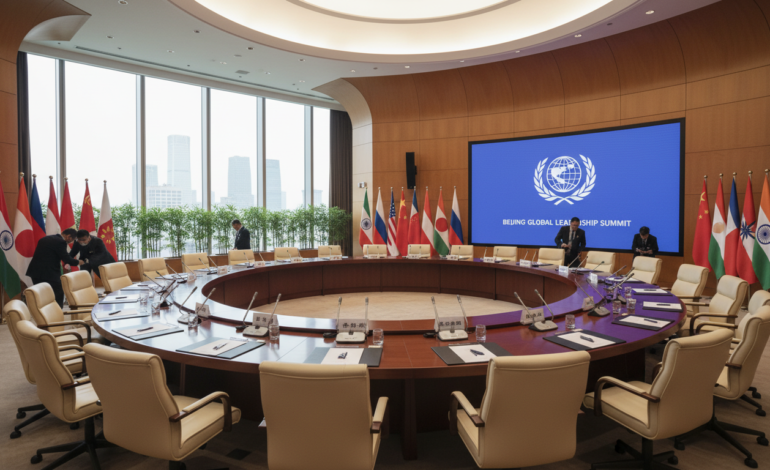
China’s Central Role in Global Diplomacy
Beijing has become the immediate arena for high stakes bargaining as delegations and markets track every public signal from Zhongnanhai. Today, foreign ministries are treating the city as a junction where security messaging, energy access, and sanctions evasion concerns intersect, with the Putin-Xi summit now shaping how briefings are written. In the middle of that pressure, China geopolitics has been pushed onto the front pages and into briefing rooms from Brussels to Seoul. Live readouts from official spokespeople are being parsed line by line for changes in language on Ukraine, trade, and technology controls. An Update cycle has formed around meeting optics, motorcade routes, and the order of statements, because small protocol choices are now interpreted as strategic intent.
Implications of the Putin-Xi Summit
Officials are watching whether communiques produce concrete deliverables or simply reaffirmations, because the distinction affects global diplomacy in the short term. Today, analysts at The New York Times framed Beijing as a focal point where Moscow seeks political cover and economic lifelines, while China measures how far alignment can go without triggering additional penalties. A Live focus has also settled on shipping, insurance, and payment channels discussed alongside energy exports, since these topics shape near term resilience. An Update on commodity pricing has been tied to broader trade conditions, including China April Exports Surge, Surplus Widens Further, which is being cited in business coverage as context for Beijing’s negotiating posture. Separately, the South China Morning Post described policy efforts to accelerate decarbonisation through construction incentives in CIC Sustainable Construction Award changes, underscoring how climate messaging is being folded into diplomatic branding.
Strategic Outcomes for China and Russia
Beijing is signaling that its priorities remain stability and leverage, while Moscow is emphasizing endurance and alternative markets, a pattern consistent with recent public statements from both governments. Today, China-Russia relations are being tested by the need to show unity without handing opponents a clear escalation hook, and that tension is central to how the Putin-Xi summit is being interpreted. In practical terms, the negotiating space often centers on settlement mechanisms, long term energy contracts, and industrial cooperation that can be framed as civilian. Live monitoring by sanctions lawyers and compliance teams focuses on how wording might affect bank risk models and export screening. In an Update worth watching, the way Beijing communicates its ties to Washington will matter too, given the backdrop captured in Xi-Trump summit signals next phase in ties now, which highlights how China calibrates parallel tracks with major powers.
Global Reactions to Beijing’s Diplomacy
European and Asian officials are responding with a mix of caution and engagement, and they are using press conferences to set red lines without closing channels. Today, several capitals are linking their messaging to enforcement of existing restrictions, while still leaving room for talks on trade and climate, and officials in Brussels have described the coordination as a same day effort. The Live diplomatic choreography includes rapid calls among allies after each Beijing statement, a practice diplomats describe in briefings as necessary crisis management. An Update in policy circles is how China frames its role as a mediator, because audiences differ sharply on whether that stance is credible. For public accountability, many newsrooms are leaning on primary documents and transcripts, and the continued international attention is turning routine protocol into a test of narrative control.
Potential Long-term Geopolitical Shifts
The longer horizon question is whether Beijing can convert attention into durable influence without absorbing the costs of Russia’s confrontation with the West. Today, governments across the Indo Pacific are evaluating how China geopolitics could reshape alignments on technology controls, supply chains, and security partnerships, and officials in Seoul have flagged the issue in briefings. A Live concern is that repeated summitry normalizes blocs, making it harder to restore flexible issue based coalitions. In the middle of this assessment, the Putin-Xi summit serves as a reference point for how far strategic coordination can extend under pressure. The next Update to watch is not a single pledge but the accumulation of operational details, including payment routing, shipping practices, and regulatory guidance, because those mechanics determine whether diplomacy becomes a lasting shift or a temporary spotlight.