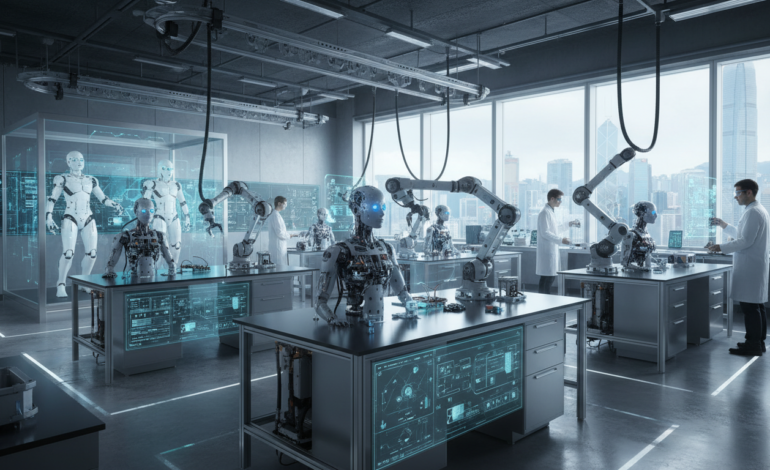
CUHK launches humanoid lab to advance robotics
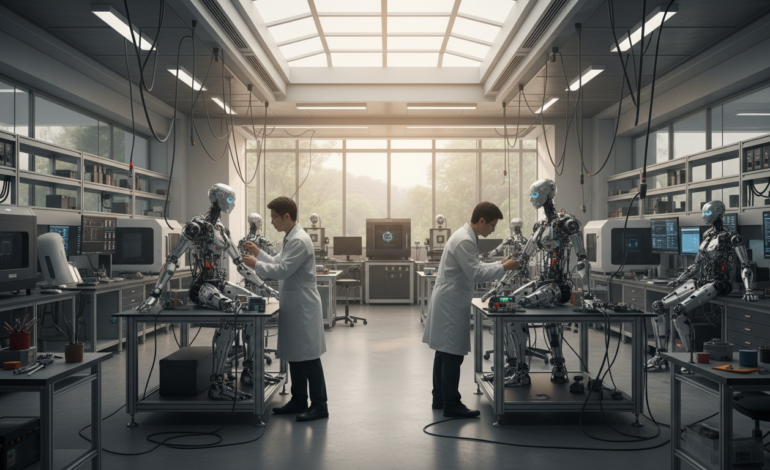
CUHK Partners with Tech Firms for Robotics
CUHK has opened a humanoid focused facility and is framing it as a translational program, aimed at moving prototypes into field trials under tighter industry feedback cycles. Today, university administrators said the lab will work with technology firms on shared testing protocols and application driven milestones, with timelines managed as rolling deliverables rather than long academic cycles. In the first set of briefings, faculty emphasized that the Hong Kong robotics lab will prioritize joint evaluation, so partner engineers can compare locomotion, dexterity, and safety behavior using consistent benchmarks. Live coordination meetings are being scheduled with corporate research teams, and an Update cadence is planned for quarterly demonstrations across multiple task settings. The university said the goal is faster validation without sacrificing peer review.
Features of the New Robotics Lab
The new space is being positioned around full body humanoid integration, including perception stacks, motion planning, and compliant actuation, with instrumentation designed for repeatable trials. Today, CUHK researchers described a workflow that couples simulation to physical testing, with logs captured for model retraining and safety auditing. The South China Morning Post outlined regional investment interest in applied AI products in its coverage of Baidu and other firms, offering context for why CUHK robotics is leaning into systems engineering, see SCMP on Baidu AI as a business driver. Live sensor fusion and on robot inference are core design targets, and an Update stream of performance notes is expected to guide iterative hardware and software revisions. Staff also highlighted safety cages and human interaction test zones for supervised trials.
Impact on AI Talent Development
CUHK is aligning the lab with workforce training goals, emphasizing hands on roles that blend mechanical design, embedded software, and model deployment. Program leaders said students will rotate through build and test phases that mirror industrial release cycles, so teams learn to document failures and translate fixes into reproducible procedures. In that context, the Hong Kong robotics lab is expected to host joint seminars with engineers from partner companies and to publish engineering notes alongside academic papers. For broader regional policy and economic context often discussed by local executives, CUHK also pointed readers to China April Exports Surge, Surplus Widens Further as an example of how external demand can shape technology investment priorities. Live lab sessions are planned for capstone teams, and each cohort will deliver an Update report that records dataset changes, safety checks, and on robot evaluation results.
Future Prospects of Humanoid Robotics
Researchers at CUHK argue the most immediate prospects are not spectacle demonstrations but constrained deployments, such as structured inspection routes, lab automation, and supervised logistics tasks where environments are mapped and safety boundaries are clear. They said progress will be judged by task reliability, recovery behaviors after slips or mis grasps, and the ability to follow human instructions without unpredictable motion. The Hong Kong robotics lab is positioning its roadmap around incremental validation, starting with standardized manipulation and controlled mobility tests before expanding to multi step workflows. Live trial data will be shared within partner consortia to compare results across hardware variants, and readers can track Baidu results highlight strong growth in core units for signals on enterprise AI demand. A public Update schedule will be used to report what succeeds and what fails.
Challenges in Robotics and AI Integration
CUHK researchers are also candid that integration remains the hardest part, because humanoid performance depends on tight coupling across mechanics, sensing, and learning systems. Engineers involved in the launch said compute and power budgets constrain on robot models, while network latency can limit remote assistance in safety critical moments. They described ongoing work to reduce sim to real gaps, since behaviors trained in simulation can fail under friction changes, lighting shifts, or sensor drift during continuous operation at the CUHK campus in Sha Tin. Live monitoring and incident logging are being built into test protocols so every fall, collision, or near miss triggers an Update review with corrective actions. The university also emphasized responsible evaluation, including human subject oversight for interaction tests and clearer metrics for safety margins. Those constraints, they said, will shape the pace of any rollout into public facing environments.