China loosens access to Nvidia H200 chips for AI labs
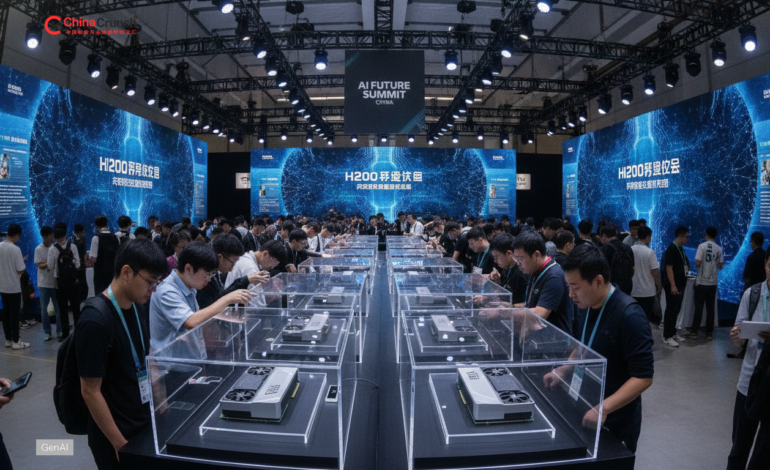
China loosens access to Nvidia H200 chips
According to available reports, China is creating a controlled pathway for select research groups to buy Nvidia’s H200 accelerators, a move aimed at keeping frontier model work on schedule while domestic alternatives scale. For labs dependent on high end accelerators, access to Nvidia H200 chips could shorten training cycles and make compute planning more predictable, but the policy is presented as conditional and subject to compliance requirements. As described in reporting in 2025, regulators appear to be making a tactical adjustment rather than a broad reopening, with eligibility, quantities, and end use expected to be defined through approval conditions. The shift is also framed as an attempt to avoid abrupt procurement swings that can disrupt supply chains and research milestones.
Who can buy H200 accelerators and how approvals work
Reporting on the shift frames it as limited access for top tier labs, with approvals routed through designated channels and controlled purchasing conditions. The South China Morning Post, although its reliability is uncertain, described the move as a recalibration, not a blanket allowance, and indicated that eligibility and volumes are constrained. A related summary of the latest scope, including how approvals are described as being limited for top tier labs, is detailed in China OKs limited Nvidia H200 chips for top AI labs. For many firms, the practical impact is less about headline availability and more about whether compliant procurement timelines can match product release schedules.
Industry impact: training timelines, budgets, and competition
For leading model developers, limited access could change training cadence, compute budgeting, and the ability to compete for enterprise deals where delivery dates matter. Market sensitivity to accelerator availability has been visible in adjacent narratives such as Alibaba stock rise in Hong Kong as AI, chips drive jump, where AI chip supply themes can move sentiment. If approvals are concentrated among a narrow tier, it may widen the gap between top labs and the rest of the market, particularly if secondary market sourcing becomes riskier. It may also reduce reliance on intermediaries, which can add cost and compliance uncertainty. In practice, H200 access may become a differentiator for which projects get priority when compute remains scarce.
Why Nvidia H200 chips matter for China’s AI progress
H200 class accelerators matter because they can compress training and inference cycles for large models, improving iteration speed and deployment economics. That performance can make Nvidia H200 chips a bridge option while domestic silicon matures, but it also raises policy sensitivity around where the compute is deployed and which entities can access it. Chinese labs have also explored custom silicon to manage unit costs, while highlighting the risk of heavy upfront investment when architectures shift quickly, as described in its reporting on custom chip strategies. The limited purchase window could reduce near term bottlenecks without changing long term substitution goals.
What this means for China-US tech relations and exports
The immediate effect may be clearer segmentation of who can obtain high end accelerators and for what use cases, which could reduce ambiguity for compliant procurement but increase competitive pressure on excluded firms. Over time, the approach could reinforce parallel tracks: continued reliance on imported accelerators for premium workloads and deeper investment in local stacks aligned with technology self-sufficiency. The broader context remains the US export control environment, which sets performance and end use ceilings and can shift as priorities change, including changes introduced since 2022. For China, allowing limited purchases may help prevent abrupt compute shortages from derailing strategic programs while keeping access conditional. For Washington, it suggests restrictions can shape, but may not fully determine, how quickly Chinese labs sustain advanced development cycles.