China humanoid robotics industry hits scaling point
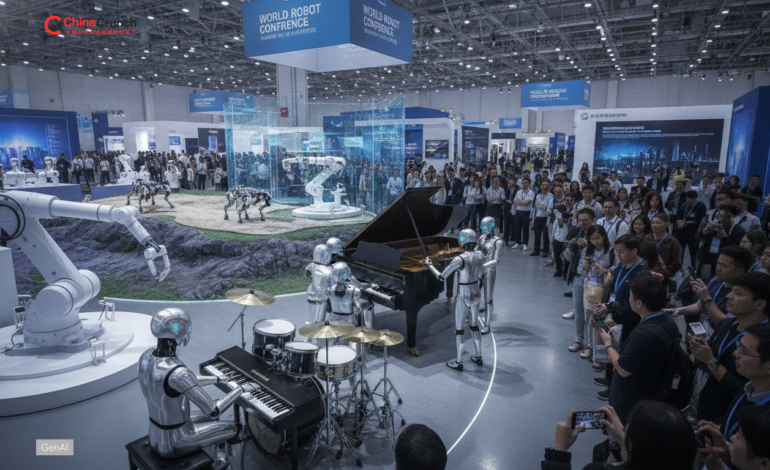
China Humanoid Robotics Industry Shifts From Demos to Scale
China’s robot makers are evolving beyond competition solely focused on stagecraft at trade shows. Vendors at the World Robot Conference, according to reports, directed updates at enterprise buyers rather than casual audiences. For the china humanoid robotics industry, the pressing issue is whether robots can effectively run full shifts, withstand dust and vibration, and be repaired quickly with standardized parts. Enterprise customers typically demand safety cases, traceable test logs, and clearer expectations around failure rates and liability. Over the next 12 months, companies that can develop pilots into consistent deployments across factories, warehouses, and public venues may gain a competitive edge.
Scaling Constraints: Cost, Components, and Edge Compute
The most significant constraints are practical, including component costs, compute limits at the edge, and inconsistent field data that can undermine model training. The supply chain is improving, but as noted in “From spectacle to scale: why China’s robotics firms face a ‘critical juncture’”, actuators, harmonic drives, and high-performance sensors can still drive up material costs and reduce tolerance for trial and error. Constrained access to leading accelerators, as indicated by reports, can also shape timelines and cost targets. Additionally, overseas cybersecurity and procurement scrutiny can adjust buyer risk assessments mid-contract, particularly in regulated markets.
Capital Tests: Valuations, IPO Signals, and Revenue Proof
Capital remains available but is increasingly conditional. Investors are questioning how swiftly pilots convert to recurring revenue and service contracts. Public market attention has reportedly intensified following a marquee listing described in “Unitree Robotics surges 629% to US$66 billion valuation in Shanghai share debut”. The report highlighted a 629% share surge and a US$66 billion valuation figure. The funding debate is shaped by pipelines of potential issuers, with discussions focusing on unit economics and defensible margins. A key risk in the china humanoid robotics industry is that overpricing could surpass deliverable manufacturing scale, potentially resulting in tougher down rounds or delayed expansion plans.
Data, Simulation, and Toolchains That Reduce Failure Rates
Engineering progress is shifting from impressive motion to data pipelines, simulation, and verification designed to cut iteration costs and enhance reliability. Improved robotics programming is increasingly dependent on better environment capture. Policy-compliant datasets and repeatable scenarios help validate perception and control before field rollout, as reinforced by “Making better robots depends on better data capture, Chinese firm 51World says”. The importance of digital twins for training and testing is emphasized due to common failures in edge cases such as glare, clutter, and slippery surfaces. Product teams are also using more efficient models and toolchains to fit real-time workloads into power and cost limits. This is crucial for the china humanoid robotics industry as deployments expand beyond demonstrations.
What Comes Next: Deployment Playbooks and Global Compliance
Immediate winners will likely be those that choose scenarios where robots can provide measurable savings, showing reliability through maintenance networks and standardized parts. Municipal strategies are supporting infrastructure development, including “Shanghai lays out plan to boost digital economy, catch up with Beijing, Shenzhen,” which can facilitate more testing zones and procurement channels, as reported. International growth will likely rely on clear safety certification, transparent supply chains, and robust post-sale support, rather than performance videos alone. Domestically, the focus is moving towards integrating robots into existing software systems like warehouse management tools and factory MES, allowing for monitoring, auditing, and improvement without the need for bespoke engineering each time.