AI cooperation: US and China seek guarded paths
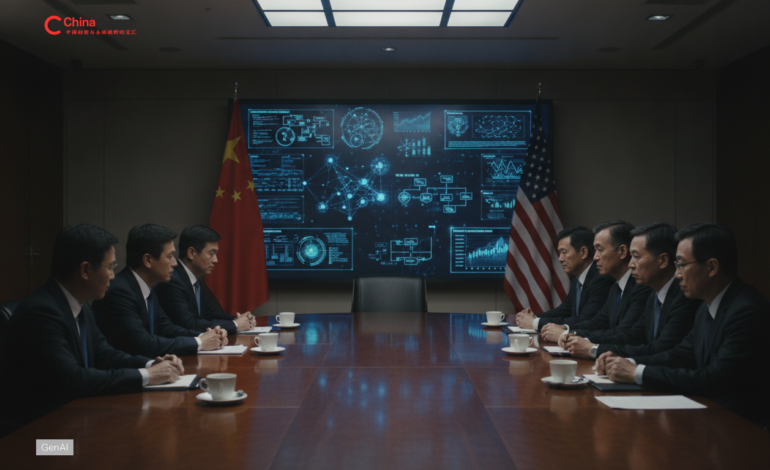
AI cooperation in US-China relations: what is changing
AI cooperation is gaining cautious attention as Washington and Beijing tighten national security controls while seeking narrow channels to manage advanced AI risks. Officials and researchers on both sides frame AI cooperation as a way to reduce misunderstandings about capability, intent, and escalation thresholds while competition persists. In the United States, the Biden administration’s October 2023 Executive Order on AI directed agencies to develop safety standards and reporting for powerful models, according to the White House. China’s Cyberspace Administration has continued enforcing rules that require security reviews and labeling for certain generative AI services, according to CAC announcements.
Security, misuse, and testing risks shaping AI cooperation
Policy makers focus on risks that spill across borders even when commercial ties are constrained. The U.S. AI Safety Institute described evaluation priorities such as cybersecurity, chemical or biological misuse, and autonomous behavior in published materials from NIST. According to available reports, Chinese regulators emphasize content integrity and platform accountability, including provider duties for training data and output management, as stated in CAC rule texts. In discussions about model testing and incident response, AI cooperation can be considered a risk management tool rather than a trust exercise. A parallel debate concerns how dual use tools are validated before deployment in sensitive sectors, where failures can scale quickly through supply chains and cloud services.
International AI governance frameworks supporting AI cooperation
Multilateral work often moves faster than bilateral diplomacy, creating reference points both capitals can use without conceding strategic ground. The G7 Hiroshima AI Process produced guiding principles and a code of conduct for organizations developing advanced AI, as indicated by G7 documentation. For a China-focused lens on compliance and security tradeoffs, China AI security: Beijing weighs US risks and rules tracks how Beijing weighs regulatory levers against external pressure. In the United Nations, member states adopted a General Assembly resolution in March 2024 promoting safe and trustworthy AI, according to UN records. These frameworks do not resolve enforcement, but they normalize shared vocabulary on testing, transparency, and accountability.
Where AI cooperation is feasible: standards, reporting, and benchmarks
Practical cooperation is most feasible where outputs are verifiable and benefits are mutual, including standardized evaluation methods, incident reporting formats, and red teaming protocols. In adjacent technology reporting, Hong Kong tests unmanned electric aircraft in maiden flight shows how safety cases and test evidence matter when autonomy enters transportation. NIST has promoted measurement-driven safety benchmarks that can be compared across labs, and the most useful elements are reproducible with published procedures. A separate example, AI courses for SMEs: Hong Kong launches free training highlights workforce readiness as a complementary piece of safer deployment and evaluation.
Outlook for AI cooperation: crisis channels and narrow verification
The most durable path might combine selective US-China collaboration with broader coalition building on standards that reduce incentives for risky deployments. Government-to-government contacts can prioritize crisis communication channels for AI-related incidents. Meanwhile, research institutions can focus on shared evaluation tasks that reveal failure modes without transferring sensitive weights or data. International AI safety work can be anchored in common test suites, model cards, and audit trails that regulators can reference, even if national rules diverge. Agencies such as NIST and China’s standard setting bodies can align on terminology and baseline metrics in public documents, then let domestic enforcement reflect local legal systems.