From Garage to Unicorn: How Chengdu Became China’s New Startup Hub
Chengdu, once known primarily for its culture and cuisine, has quietly become one of China’s fastest-growing startup hubs. Over the past decade, the city has transformed from a regional business center into a vibrant innovation ecosystem attracting entrepreneurs, investors, and multinational companies. Supported by a combination of local government policy, research institutions, and favorable living conditions, Chengdu is emerging as the “Silicon Valley of Western China.” Its unique blend of affordability, talent availability, and supportive infrastructure has created fertile ground for startups in artificial intelligence, cloud computing, gaming, and green energy. The city’s rise illustrates how innovation is decentralizing across China, moving beyond Beijing, Shanghai, and Shenzhen.
Policy Support and Local Government Strategy
Chengdu’s success as a startup hub is the result of deliberate policy planning. The municipal government introduced a series of incentive programs designed to attract technology firms and venture capital. Initiatives such as the “Tianfu Talent Plan” provide funding, housing, and tax benefits for high-skilled entrepreneurs. The Chengdu Hi-Tech Industrial Development Zone, home to more than 50,000 technology companies, offers subsidized office spaces and research grants. Local authorities also emphasize digital infrastructure, ensuring that 5G connectivity, cloud services, and data centers are widely accessible. This government-driven strategy has cultivated a balanced ecosystem where startups receive both financial and institutional support to scale rapidly.
Talent Pipeline and Academic Strength
Chengdu’s universities play a central role in nurturing its startup ecosystem. Institutions such as the University of Electronic Science and Technology of China and Sichuan University produce thousands of engineers, data scientists, and software developers every year. These graduates feed directly into the city’s growing tech firms. Academic-industry collaboration is strong, with research labs co-founded by universities and private companies focusing on emerging technologies like AI algorithms, robotics, and semiconductor design. Chengdu’s talent advantage lies not only in quantity but also in retention. Compared with Beijing and Shanghai, the city offers a lower cost of living and a more balanced lifestyle, making it easier for startups to attract and keep skilled employees.
The Growth of Venture Capital and Incubation
Venture capital has followed the momentum. Major investors from Shanghai, Hong Kong, and Singapore are increasingly establishing regional offices in Chengdu. The Chengdu Financial City Investment Group manages several funds dedicated to early-stage technology companies. International accelerators such as Plug and Play and InnoSpring have opened branches to connect local startups with global networks. The city hosts multiple annual innovation summits and pitch events that attract venture funds and corporate partners. This flow of capital ensures that promising startups can access both funding and mentorship, reducing their dependence on traditional bank loans and enabling faster scaling.
Key Sectors Driving Chengdu’s Growth
Chengdu’s startups are concentrated in several key industries. Artificial intelligence firms are developing computer vision systems for smart city management, healthcare diagnostics, and autonomous logistics. Cloud computing companies are offering localized data services to enterprises across Western China. The gaming sector is particularly vibrant, supported by the city’s strong digital art and software talent. Chengdu-based game studios supply content to global platforms and contribute significantly to China’s entertainment exports. The renewable energy sector is also expanding, with startups designing smart grid technologies and battery recycling systems. This sectoral diversity makes Chengdu resilient to market fluctuations and ensures long-term growth potential.
Infrastructure and Living Environment
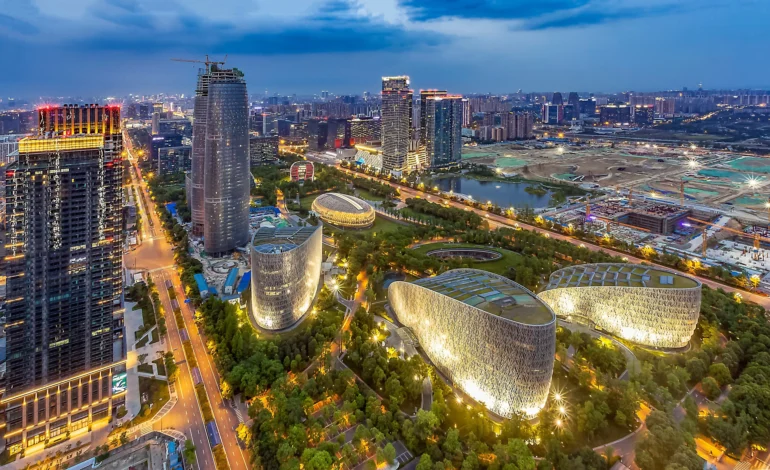
The city’s physical and digital infrastructure supports its innovation agenda. Chengdu’s Tianfu New Area, designed as a modern business district, features advanced office complexes, high-speed transportation, and international schools catering to expatriate professionals. The presence of major corporations such as Intel, IBM, and Dell further strengthens the ecosystem by providing collaboration opportunities for startups. Beyond infrastructure, Chengdu’s cultural appeal adds to its attractiveness. The city’s relaxed lifestyle, strong food culture, and scenic environment make it a preferred location for young professionals seeking work-life balance. This combination of quality of life and professional opportunity is a key factor behind the city’s rise as an innovation center.
Integration into the National Innovation Network
Chengdu’s startup ecosystem does not operate in isolation. It is deeply integrated into China’s national innovation strategy. The city serves as a western hub for digital infrastructure and logistics, connecting inland provinces with coastal markets. Its role in the Western Development Strategy ensures continued government investment in technology and connectivity. Partnerships with cities such as Shenzhen and Hangzhou enable cross-regional collaboration in AI research and product commercialization. Chengdu’s growing international presence, including trade offices in Europe and Southeast Asia, also allows local startups to explore global markets more easily. This networked positioning ensures that Chengdu remains both a regional powerhouse and a national contributor to innovation.
Success Stories and Emerging Unicorns
The success of Chengdu’s startup ecosystem can be seen through its growing number of unicorns. Companies such as DeepSea AI, which develops underwater robotics, and CloudWalk West, a spin-off of the well-known AI firm CloudWalk Technology, have achieved billion-dollar valuations. In the gaming industry, local studio Tap4Fun has gained international recognition with mobile titles that reach global audiences. Startups in fintech and logistics are also scaling rapidly, driven by the region’s e-commerce growth and strategic location along China’s western trade routes. These success stories inspire local entrepreneurs and demonstrate that Chengdu can produce globally competitive companies from within its innovation ecosystem.
Collaboration and Community Culture
One of Chengdu’s defining strengths is its collaborative spirit. The city’s co-working spaces, incubators, and maker hubs encourage cross-industry interaction. Entrepreneurs, researchers, and designers often share resources and exchange ideas freely. This culture of openness is supported by local media and government initiatives that promote entrepreneurship as a social value. Regular hackathons, innovation fairs, and startup competitions bring together talent from across China and abroad. The emphasis on collaboration over competition helps sustain long-term partnerships and collective learning. This community-driven approach is essential for maintaining innovation momentum in a rapidly evolving technological landscape.
Challenges and Future Goals
Chengdu’s startup boom faces challenges that accompany rapid growth. Competition for high-level talent is increasing as more firms enter the market. Infrastructure expansion must keep pace with demand, and venture capital allocation can still be uneven across sectors. The city also needs to strengthen intellectual property protection to attract more international partnerships. However, local authorities are aware of these issues and are implementing reforms to ensure sustainable growth. Plans include expanding research funding, improving legal frameworks, and deepening cooperation with global innovation hubs. These efforts will help Chengdu transition from an emerging startup hub to a mature, globally recognized innovation powerhouse.
Future Outlook
By 2025, Chengdu’s startup scene is expected to play a leading role in China’s westward innovation strategy. The combination of policy support, talent concentration, and global connectivity positions the city for continued success. As it builds more accelerators, research centers, and international partnerships, Chengdu will likely produce a new wave of unicorns across AI, cloud computing, and GreenTech. Its transformation from a regional city to a global innovation hub reflects the evolution of China’s economic geography one that values balanced, sustainable, and inclusive technological growth.
Conclusion
Chengdu’s journey from garage startups to unicorns symbolizes the decentralization of China’s innovation story. It shows that global-class entrepreneurship is no longer confined to coastal megacities. The city’s success lies in its mix of policy foresight, research excellence, and cultural vibrancy. As startups scale and industries diversify, Chengdu stands as proof that innovation can thrive wherever vision meets infrastructure and community. In the coming years, it will continue to serve as a model for emerging tech ecosystems across China and beyond.