Swiss Robotics Expert Praises China’s Ability to Scale Physical AI and Industrial Automation
A leading Swiss robotics expert has highlighted China’s growing strength in scaling robotics and physical artificial intelligence, pointing to the country’s integrated industrial ecosystem and rapid deployment capabilities as key competitive advantages in the global AI race.
Dominic Gorecky, co founder and director of the Swiss Smart Factory and president of the Swiss Robotic Competence Center, said in a recent interview that China has developed a clear national strategy aimed at becoming a global robotics powerhouse. According to Gorecky, China, the United States and Europe each play distinct but potentially complementary roles in today’s artificial intelligence landscape.
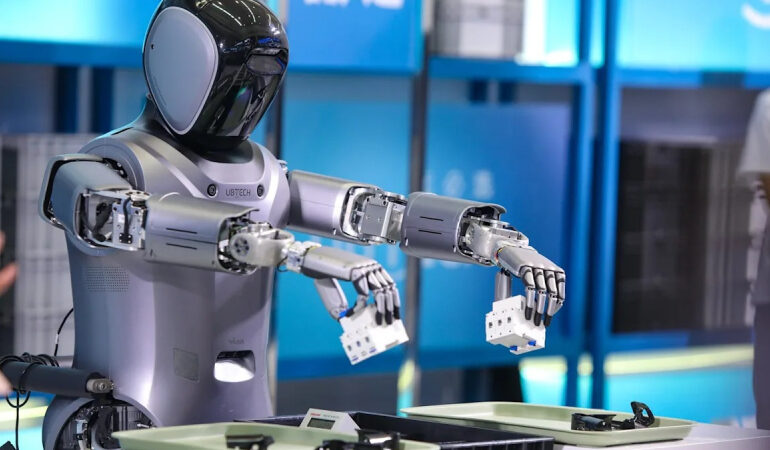
He noted that China has made rapid advances in robotics and what is increasingly referred to as physical AI, where intelligent systems are embedded directly into machines and industrial processes. A central strength, he said, lies in China’s ability to integrate hardware, manufacturing and AI software into cohesive systems that move quickly from prototype to mass deployment.
Gorecky also pointed to China’s emphasis on cost efficient open source models, including platforms such as DeepSeek, which he believes can deliver competitive performance while reducing computational expenses. This focus on affordability and scalability, combined with large domestic manufacturing capacity, allows Chinese firms to iterate quickly and roll out technologies at industrial scale.
By contrast, Gorecky described Europe’s competitive edge as rooted in advanced engineering standards and a long term commitment to sustainability. European AI solutions are often deployed in complex industrial and safety critical environments, where reliability and regulatory compliance are paramount. However, he acknowledged that Europe faces structural challenges in commercializing and scaling digital innovations compared with both China and the United States.
The Swiss Smart Factory, located in Biel within the Bern region, has been conducting Industry 4.0 research and innovation since 2017. Gorecky said Switzerland has fostered close collaboration between universities, startups and established industrial firms in areas such as autonomous robotics, manufacturing automation and medical technology. Networks like the Swiss Smart Factory have helped position the country as a hub for applied industrial innovation.
Looking ahead, Gorecky described artificial intelligence as entering a new phase of development. Early AI systems were largely analytical, while recent years have seen the rise of generative models integrated into everyday applications. The next step, he suggested, will involve more autonomous agent based systems capable of pursuing goals, adapting strategies and operating as collaborative digital partners within industrial and business environments.
As global competition intensifies, Gorecky’s remarks underscore the shifting balance of strengths in robotics and physical AI, with China’s scaling capacity emerging as a defining factor in the next wave of intelligent manufacturing.