AI maps China renewables as data centers surge fast
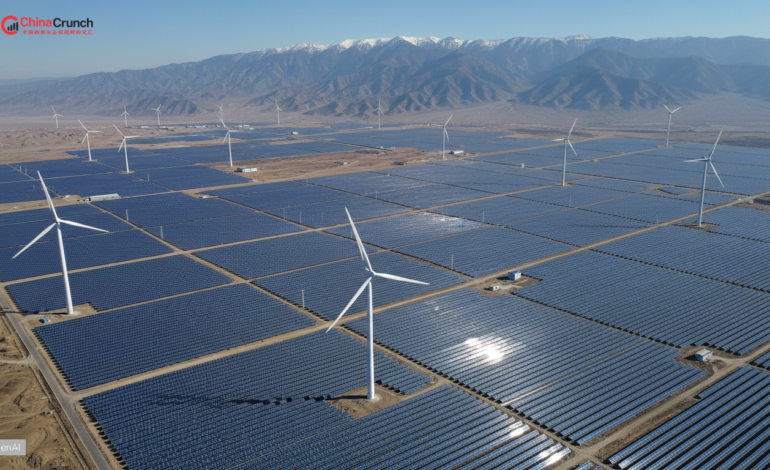
China’s Ambitious Green Energy Targets
Grid planners in China are moving faster on renewable build outs as heat and demand shifts squeeze regional power balances. In the middle of this work, China AI energy mapping is being framed as a practical way to align policy goals with real output and land use constraints. Today, provincial dispatch centres are using more digital tools to verify where new projects are actually generating and where curtailment risk is rising, including in provinces such as Inner Mongolia and Gansu. The National Energy Administration has repeatedly highlighted renewables and grid flexibility in its public notices, and an Update cycle of approvals is pushing more projects into construction. Live operations teams are also watching how weather volatility changes hourly generation patterns.
Role of AI in Mapping Solar and Wind Infrastructure
Utilities and developers are increasingly relying on computer vision to check asset locations, capacity labels, and connections to nearby substations. An external account by the South China Morning Post described an AI system that can identify solar installations and wind farms from imagery and produce a near continuous inventory, which operators can treat as a Live layer for planning. In parallel, editors at China AI innovation drives a new knowledge economy have tracked how machine learning tools are being adopted across industrial workflows, including energy data verification. Today, the operational value is speed, giving planners an Update mechanism for permitting checks, land compliance screening, and output forecasting without waiting for manual field surveys.
Collaboration with Alibaba’s Damo Academy
The mapping push is also tied to research and commercial partnerships that can scale models across provinces with different terrain and grid rules. The South China Morning Post reported that Alibaba’s Damo Academy is involved in developing the approach described, connecting AI research to energy sector deployment. In a separate note on company direction, the South China Morning Post detailed Alibaba’s shift toward commercialisation in its AI work, which helps explain why energy clients want products that integrate with existing dispatch software. Live model performance is typically judged on detection accuracy, false positives, and the time it takes to deliver an Update after new construction, and this is being tested against imagery over provinces such as Shandong and Jiangsu. Today, partners are also emphasising audit trails so regulators can validate how each identification was made.
Impact on Data Centers and Energy Efficiency
Data centres are tightening the link between clean generation and local load, especially where clusters are expanding near coastal demand hubs. Today, operators need clearer signals about which renewable assets are delivering firm power and which depend on transmission availability, and China AI energy mapping can shorten that visibility gap for procurement teams. Coverage at AI Boom Drives Asia-Pacific Data Center Spending has outlined how the regional build cycle is accelerating, raising the stakes for granular energy sourcing and efficiency metrics. Live monitoring also supports claims around clean electricity matching, because operators can compare asset detection with settlement and grid dispatch data. An Update cadence that tracks new grid connections can reduce the risk of contracting for projects that are delayed or constrained.
Future Implications for China’s Energy Strategy
Beijing’s next steps will likely focus on standardising data formats so the same renewable inventory can be used by regulators, utilities, and large buyers without rework. Today, the key policy question is how to turn detection into dispatch value, meaning better congestion forecasting, faster interconnection planning, and clearer accountability when projects underperform. Live integration with satellite and aerial datasets could also strengthen enforcement against misreporting, while giving planners a higher confidence view of where grid upgrades are most urgent, including along major transmission corridors such as West-to-East lines. The National Energy Administration has signalled in its releases that improving system flexibility is central to the green transition, and an Update driven planning cycle could make approvals more consistent across regions. Execution will depend on transparent benchmarks and verifiable model outputs.