Chinese Coastguard Expands Drone Operations Near Scarborough Shoal
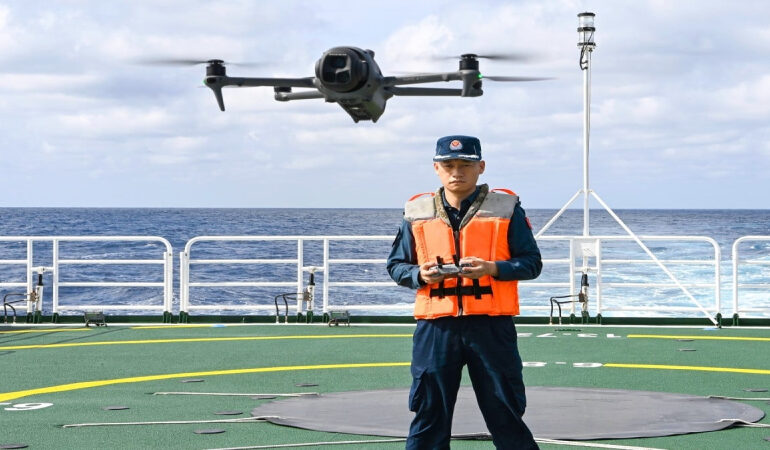
China’s coastguard has offered a rare public look at its growing reliance on aerial drones during patrol and training missions near Scarborough Shoal, a disputed reef in the South China Sea. A Lunar New Year social media post showcasing officers stationed aboard the coastguard vessel Wanshan highlighted how unmanned systems are now embedded in routine maritime operations.
The images and footage, released during the holiday period, showed crew members deploying and operating drones from the deck while conducting surveillance drills. While the post was framed as a festive update from personnel on duty, it revealed the increasing operational importance of aerial platforms in contested waters known in China as Huangyan Island.
Drones are being used to extend situational awareness far beyond the visual range of coastguard ships. From altitude, unmanned aircraft can monitor surrounding vessels, track maritime activity and relay real time imagery back to command centers. This capability is particularly significant in areas like Scarborough Shoal, where overlapping territorial claims have made the waters strategically sensitive.
The use of drones complements traditional helicopter patrols, which remain a visible part of maritime enforcement operations. However, unmanned systems offer cost advantages and longer endurance. Smaller drones can be launched quickly from patrol ships, require fewer personnel and operate with lower logistical demands than crewed aircraft.
China has invested heavily in domestic drone manufacturing over the past decade, developing both civilian and security focused platforms. Advances in battery life, imaging technology and encrypted communication systems have enabled broader deployment across maritime, border and emergency response agencies. In maritime contexts, drones can assist in law enforcement inspections, environmental monitoring and search and rescue coordination.
Scarborough Shoal has been a focal point of regional tensions for years, making persistent monitoring a strategic priority. The integration of drones into coastguard routines suggests a shift toward more technology driven maritime governance. Analysts note that unmanned aerial systems allow authorities to maintain a visible presence while reducing direct ship to ship confrontation risks.
Beyond surveillance, drone training appears to be incorporated into daily readiness programs. The Lunar New Year post depicted structured exercises rather than ad hoc deployment, indicating that operators are being formally trained in launch, navigation and data relay procedures. This institutionalization reflects how unmanned systems are becoming standard equipment rather than supplementary tools.
As maritime disputes in the South China Sea continue to draw international attention, technological modernization is reshaping how coastal states manage contested areas. The coastguard’s latest disclosure underscores a broader pattern of digital integration across China’s maritime security apparatus, with drones increasingly central to observation, communication and operational planning in strategically important waters.