Hang Seng Tech Index lags as AI rally bypasses Hong Kong heavyweights
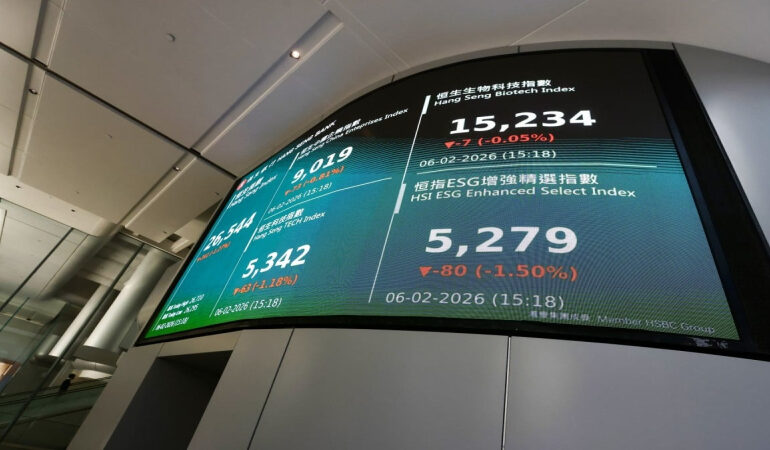
Hong Kong’s benchmark for technology shares is trailing broader markets this year, even as global investors pour capital into artificial intelligence related stocks. The divergence has raised questions about sector composition and whether the city’s flagship tech gauge is positioned to benefit fully from the current AI driven investment cycle.
The Hang Seng Tech Index, which tracks 30 major technology related companies listed in Hong Kong, has declined about 5.5 percent so far this year. This follows a strong rebound in the previous year when the index gained more than 23 percent. By comparison, the broader Hang Seng Index has edged up roughly 0.3 percent over the same period, while the Nasdaq 100 in the United States has slipped around 0.8 percent.
The Hang Seng Tech Index includes prominent mainland Chinese firms such as Tencent Holdings, Alibaba Group Holding and Meituan. While these companies have significant digital ecosystems and cloud operations, analysts say they are not viewed as pure play artificial intelligence stocks in the same way as certain US semiconductor designers or AI infrastructure providers.
Global markets in 2026 have been characterised by strong performance in companies directly linked to AI chips, data centre hardware and advanced software models. Investors have focused on firms with clear revenue acceleration tied to generative AI deployment. In contrast, many constituents of the Hang Seng Tech Index derive substantial income from online advertising, ecommerce and consumer services, sectors that face slower growth and regulatory headwinds.
Market strategists also point to structural factors. The weighting of the Hang Seng Tech Index is concentrated in a handful of mega cap internet platforms. This concentration means that weakness in one or two large names can drag down overall performance. Meanwhile, emerging AI focused hardware manufacturers and semiconductor suppliers listed in mainland exchanges or overseas markets are not fully represented in Hong Kong’s tech benchmark.
Valuation dynamics have further complicated the picture. Some Hong Kong listed technology stocks saw sharp gains in late 2025 on expectations of policy support and economic stabilisation. As those expectations moderated, investors rotated toward companies with clearer AI exposure and stronger earnings momentum. The result has been a relative underperformance for the index despite ongoing enthusiasm for artificial intelligence across global markets.
Liquidity trends and capital flows have also played a role. International funds have selectively increased allocations to US and certain mainland Chinese AI leaders, while remaining cautious on Hong Kong listed consumer internet platforms amid macroeconomic uncertainty. This selective approach has amplified differences between headline AI optimism and the actual performance of the Hang Seng Tech Index.
Analysts note that the index’s future trajectory may depend on whether its largest constituents can demonstrate tangible revenue gains from AI integration, including in cloud computing, digital payments and enterprise services. The ability of Hong Kong’s market to attract listings of next generation semiconductor and AI infrastructure firms could also influence how closely the benchmark tracks the broader artificial intelligence rally.