China Intensifies Technology Race With United States as New Five Year Plan Focuses on AI and Industrial Innovation
China has unveiled an ambitious strategy to accelerate technological breakthroughs and expand artificial intelligence across its economy as rivalry with the United States intensifies. The plan forms part of Beijing’s latest five year economic roadmap, which places advanced technology at the center of the country’s long term development strategy. Chinese leaders believe that scientific innovation and digital industries will become the main engines of growth as traditional sectors such as property and infrastructure face structural pressures. The policy direction reflects a growing focus on strengthening national technological capabilities while protecting supply chains from geopolitical disruptions.
The new development blueprint outlines a future where artificial intelligence and advanced automation play a central role in China’s industrial system. Policymakers expect intelligent machines and robotics to transform factory production, logistics networks and research laboratories over the coming decade. Artificial intelligence is expected to support large scale data analysis, manufacturing optimization and digital services that could improve productivity across multiple sectors. The plan also envisions greater integration between AI technology and national data infrastructure to support industrial decision making and digital governance systems.
Government leaders have emphasized that technological innovation will remain a top national priority. Investment in research and development is expected to continue rising as Beijing seeks to close technology gaps in areas such as semiconductors, advanced computing and high performance manufacturing. Officials have indicated that new scientific programs will focus on emerging technologies including quantum computing, advanced materials, biotechnology and intelligent robotics. These fields are viewed as critical to long term economic competitiveness and national security in an increasingly technology driven global economy.
China’s leadership has set an economic growth target in the range of approximately four and a half to five percent as policymakers attempt to balance industrial expansion with structural economic challenges. Analysts say the slightly lower growth target reflects ongoing concerns about weak domestic consumption, high local government debt and instability in the property market. While the government aims to increase consumer spending gradually, many economists believe the broader strategy remains heavily focused on investment and manufacturing led growth rather than immediate structural rebalancing.
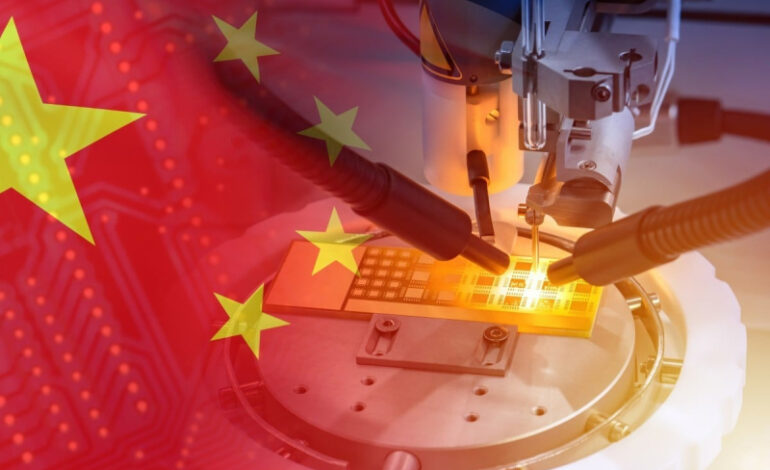
The emphasis on technology also reflects the impact of rising geopolitical competition between China and the United States. Export controls, tariffs and restrictions on advanced semiconductor technology have reshaped the global technology landscape in recent years. In response, Chinese policymakers have accelerated efforts to build domestic capabilities in key industries ranging from semiconductor manufacturing to artificial intelligence infrastructure. Strengthening supply chain resilience has become a major objective as China attempts to reduce dependence on foreign technology providers.
Advanced manufacturing and digital industries are expected to form the foundation of what Chinese officials describe as new productive forces. The strategy includes plans to expand intelligent factories, develop high performance computing clusters and support research into next generation technologies such as brain computer interfaces and nuclear fusion. Policymakers also envision increased adoption of intelligent robots within industrial production systems to address demographic challenges and rising labor costs.
The technology driven strategy comes at a time when China continues to dominate several critical areas of the global industrial supply chain. The country remains a leading producer of rare earth materials, electric vehicle infrastructure and numerous manufacturing components essential for modern electronics and renewable energy systems. Officials believe these strengths provide a foundation for expanding influence in emerging technology industries as global competition for technological leadership intensifies.