Huawei Shows Cluster, AI Agent Phone at China AI Summit
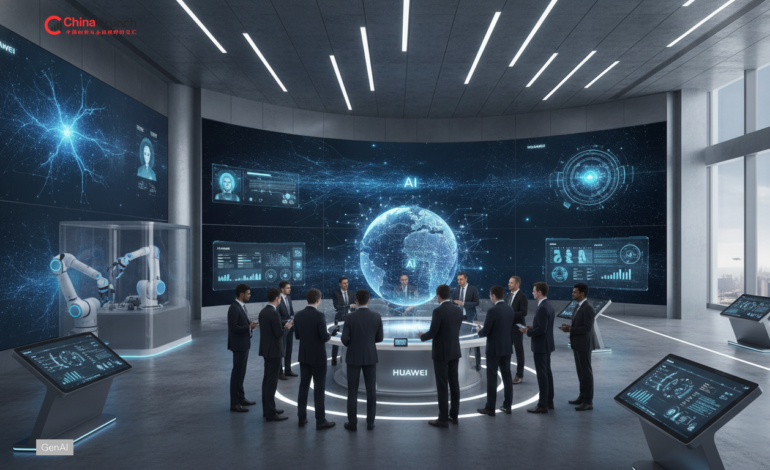
WAIC spotlight: what Huawei revealed on the China AI summit stage
At WAIC in Shanghai, Huawei is using the China AI summit track to frame its near-term priorities in AI infrastructure and consumer devices. Huawei did not publish performance benchmarks, pricing, or delivery timelines in the briefing, but it positioned the launch as a practical step toward bundled infrastructure and agent experiences. According to available reports from the South China Morning Post, the company plans to introduce a new computing cluster and what it describes as the first AI agent phone.
Huawei’s new computing cluster for large models
Huawei said its new computing cluster is designed to train and serve large models at scale for domestic developers and enterprise buyers. The move reflects a broader procurement shift: banks, telecoms, and public sector customers are seeking integrated hardware, software, and model services with clearer capacity planning. At WAIC in Shanghai, the cluster pitch also lands as investors watch China’s compute and semiconductor supply chain closely, including coverage of China semiconductor industry: CXMT IPO, HBM, risks. At WAIC, Huawei framed the system as part of a full stack delivery approach, aiming to reduce integration work for buyers moving from pilots to production and needing predictable utilization and support terms.
AI agent phone: consumer assistants showcased at WAIC
Alongside the cluster, Huawei plans to show an AI agent phone positioned as a consumer entry point for task-oriented assistants. WAIC is also where the wider ecosystem is showing related progress in embodied AI, including a separate SCMP report on Ant Group work on robot sensing. Framed within the China AI summit agenda, the bet is that agents could become a default user experience layer, shifting competition toward tool access, latency, and trust rather than only camera modules and batteries. For additional China business context, see Chinese investment in Pakistan: energy deals accelerate. However, Huawei has not disclosed technical specifications such as the on-device model, chipset details, or privacy controls. As indicated by initial briefings, the phone’s capabilities and market positioning remain speculative.
Why WAIC matters for enterprise buyers
WAIC has become a venue where platform vendors and model builders try to influence the next cycle of enterprise deployments, and the conference’s product-focused tracks increasingly emphasize deliverable systems. This year at WAIC in Shanghai, for CIOs budgeting for inference capacity and workforce tooling, the key question is whether suppliers can attach service terms to their claims, including security posture and operational reliability. This year, the competitive backdrop includes momentum in China’s chip tooling narrative and the market expectations that follow it, reflected in SCMP coverage of China’s chip equipment rally faces earnings test. Huawei’s messaging is that integrated stacks can shorten procurement cycles and make scaling more predictable.
What to watch next after the China AI summit announcements
For Chinese tech firms, the near-term test after the China AI summit is execution: reportedly shipping stable agent experiences, meeting enterprise security requirements, and keeping cluster utilization high without cost spikes. Investors will also track how AI related names trade as lock-ups end and sentiment shifts, a theme echoed in SCMP reporting on Zhipu AI and MiniMax shares and in local market coverage like Hong Kong drives fresh global interest in China stocks. Huawei’s WAIC reveal sets expectations, but customers will look for concrete delivery details, reference deployments, and clearer specifications for both the cluster and the AI agent phone. The same applies across the ecosystem as vendors push differentiated inference stacks and vertical tuning.