China US military distance strategy after sea drone strike
Distance strategy lessons drawn from a reported US sea drone strike
Beijing is reportedly parsing Washington’s reported use of an unmanned surface platform to hit a maritime target for operational and political signals, as suggested by The South China Morning Post. In this reading, the key lesson is less about blast effect and more about how sensing, authorization, and precision engagement were coordinated in a crowded littoral, as analysts have suggested in public discussion. That is where the focus keyphrase comes in: keeping high value crews and major platforms outside the most dangerous rings while still applying credible pressure through unmanned systems and networked fires, as described by observers of modern naval operations. Analysts also ask what conditions made the strike possible, including sea state, local air defense posture, and the time available to confirm a target before engagement, though specific details vary by account.
What the strike suggests about escalation and proximity
For the PLA, the immediate question is how to translate the episode into China military strategy without copying tactics that may be detached from local geography, according to defense commentary suggested by The South China Morning Post. Maritime coercion is often described by researchers as working best when paired with resilient command networks and consistent access to target quality intelligence. In that context, officials and scholars tracking regional friction often point to China-US maritime tensions: three flashpoints to watch as a reminder that escalation ladders are shaped by proximity, signaling space, and time to deconflict. The national military strategy debate frequently emphasizes denying an opponent safe approach lanes rather than chasing a single platform, as framed in public writings on area denial concepts. The strike story is also cited by commentators as reinforcing that low cost systems can still carry high consequence messaging and miscalculation risk.
Port and coastal defense upgrades under standoff operations
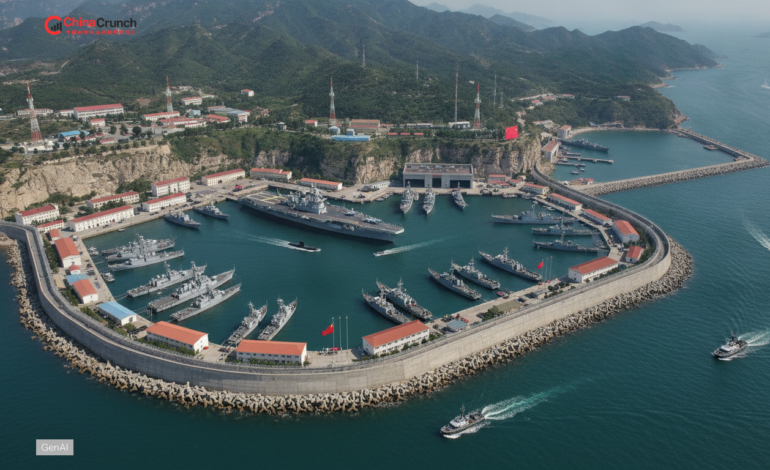
Coastal defense planning is increasingly coupled to harbor security because drones can probe gaps that were once masked by distance and weather, according to open technical discussions and reporting on unmanned systems. For a technology comparison on sensor and processor constraints, China chip strategy: global ties amid export curbs shows how supply limits can shape what can be fielded at scale. Sea defense upgrades often emphasize layered detection, including electro-optical coverage, passive acoustic cues, and radar tuned for small cross section contacts, as described in publicly available technical material. The logic aligns with a standoff-oriented approach by forcing defenders to manage many small threats while preserving key assets and sortie generation. A practical lesson is that hardening is not only about barriers; it is also about sustaining repair capacity and traffic control under harassment, as port security practitioners commonly note.
Drone kill chains, electronic attack, and decision speed
Accounts of the incident are used by commentators to illustrate how unmanned surface vehicles can be used as shooters, decoys, or intelligence collectors depending on payload, autonomy, and mission rules. For a broader view of how data discipline shapes outcomes in complex systems, Rethinking leadership for a changing world echoes the challenge of turning noisy feeds into actionable tracks. What matters for planners is kill chain integrity: reliable communications, navigation assurance, and discrimination in cluttered littorals where jamming and spoofing are expected, as indicated in public research and doctrinal discussions. Chinese defense researchers have publicly discussed multi-sensor fusion for small targets, but operational performance is generally judged by observers based on whether systems remain effective under electronic attack and degraded links, where details are often not fully disclosed. Beyond hardware, analysts often argue the limiting factor is decision speed and disciplined data handling across the command chain.
What may change next in China naval security posture
Near term adjustments are likely to center on readiness, experimentation, and clearer rules for when unmanned contacts trigger warning, interception, or escalation, as suggested by public commentary on maritime risk management. In this frame, china us military distance strategy is treated as a way to keep key forces outside the most dangerous rings while still influencing events through unmanned contacts and networked surveillance. Exercises that stress identification, safe standoff response, and proportionality are often described as a way to reduce the chance that a low cost drone produces a high cost incident. A key policy angle is attribution: deterrence depends on credible forensics and timely public messaging, which typically requires persistent monitoring networks around ports and sea lanes, according to analysts. China’s shipbuilders and labs are often described in reporting as oriented toward modular payloads and faster production cycles, which could shorten the loop between concept and fielding. The broader impact of the sea drone strike story, as framed by observers, is to push planners toward more distributed defense, tighter port protection routines, and better integration across services while remaining consistent with china us military distance strategy.