China AI policy urged to avoid split with US on rules
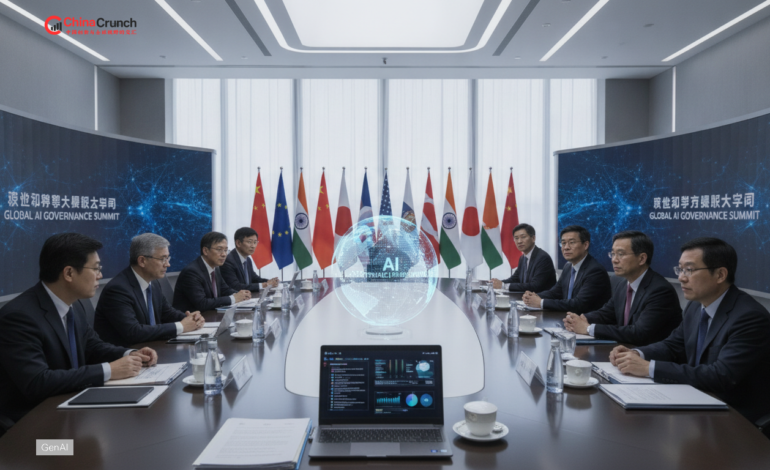
China AI policy and global AI governance strategy
China AI policy is under pressure as experts urge Beijing to frame rulemaking as compatible with global norms, not a rival bloc. According to available reports, specialists said China should keep channels open to Washington while tightening domestic guardrails for frontier systems. The discussion has sharpened as regulators link AI oversight to industrial planning, security review, and data governance. Analysts warned that a divided posture could hinder technical alignment on safety evaluations, incident reporting, and shared terminology. Officials have not issued a single unified national code, but agencies continue to signal that China AI policy compliance checks and security assessments will shape market access across sectors.
International cooperation challenges for shared AI rules
Diplomats and standards bodies face friction as AI governance talks become intertwined with trade controls and chip supply restrictions. Reuters quoted experts warning that strategic rivalry can crowd out technical work on benchmarks, model transparency, and testing protocols that would benefit multiple regions. For a near term illustration of industry momentum, the South China Morning Post reported China’s richest province taps Alibaba to power its AI and chip push, underscoring how local initiatives can move faster than multilateral rulemaking. A related investment and security debate is visible in parallel policy domains, including Chinese investment in Pakistan faces US transshipment scrutiny, where compliance questions shape cross border engagement.
Analysts warn of a US China AI rules split
Researchers interviewed by Reuters said the main risk is regulatory divergence that becomes self reinforcing once firms build separate compliance stacks. Corporate governance also matters for adoption pathways, as seen in Alibaba AI model Qwen3.8-Max gets tighter license, where tighter terms can affect downstream integration. They cautioned that if both sides codify incompatible definitions for high risk models, audits, and red team testing, cross border collaboration could shrink even in non sensitive scientific areas. The warning extends to incident disclosure because inconsistent thresholds reduce comparability and slow fixes. Analysts said international AI cooperation works best when baseline safety practices remain mutually recognizable.
Impact on global AI development and industry momentum
For developers outside the two powers, a bifurcated rule set would mean duplicated compliance work and slower launches across markets. Reuters noted that split regimes could limit shared testing resources and reduce the incentive to publish safety tooling that works across jurisdictions. Industry direction also matters because product design often follows the strictest rules a company must satisfy, shaping content filters, data retention, and access controls. In parallel, the South China Morning Post covered DeepSeek’s Harness, a pivot that raises new oversight questions for systems that plan and act. Market signals from chips to models feed this cycle, including Chinese chipmakers profit rises on AI foundry demand, which highlights how AI demand can accelerate domestic scaling.
Future US China relations and practical policy bridges
Reuters emphasized that avoiding a hard split does not require surrendering national priorities, but it does require practical bridges such as joint terminology and comparable safety testing. Experts argued that mutual recognition of certain audit practices could reduce friction even while export controls and security screenings persist. They also said that creating venues for technical dialogue, including standards discussions, can keep communication alive when political relations worsen. China AI policy choices will influence how companies interpret acceptable risk and how researchers share tools across borders. A limited agenda focused on concrete safety tasks, such as vulnerability disclosure and evaluation metrics, would still offer measurable gains.