J-36 fighter jet: China adds more prototype airframes
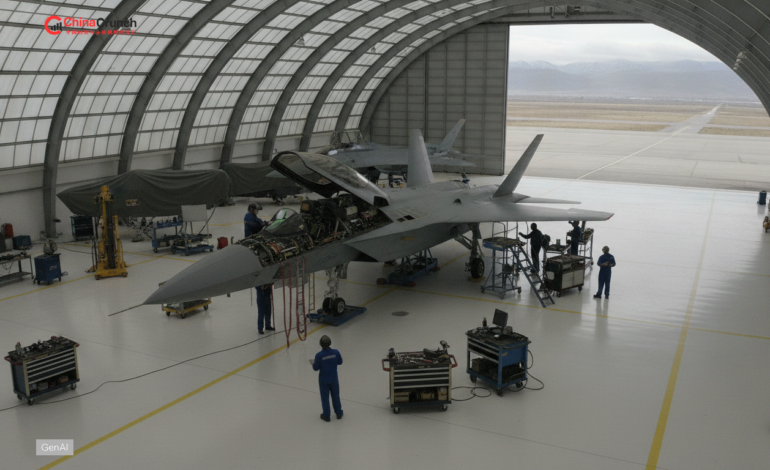
J-36 fighter jet prototypes added to China test fleet
The J-36 fighter jet is drawing fresh attention after new images circulated online in late July 2026 that appear to show an additional airframe, which, according to available reports, this could suggest a fifth prototype. For programs at this stage, adding test aircraft is generally understood to support parallel work on flight controls, avionics integration, and handling trials, while potentially tightening the loop between flight-test findings and design updates. State media have not confirmed an official designation timeline or specifications, so open-source assessments rely on comparing photographed airframes, markings, and visible configuration differences. If those assessments are correct, it may indicate the program is widening its test pool rather than relying on a single proof-of-concept aircraft.
What the added airframes could mean
More prototypes can expand sortie capacity for envelope expansion, radar and datalink checks, and electronic-warfare evaluations, which may influence readiness signaling. A wider prototype pool also enables instrumented test flights to run in parallel with maintainability checks, ground-handling work, and subsystem reliability trials. For a broader view of how technology programs become proxies for national ambition, a related read is Unitree Robotics IPO puts spotlight on US-China rivalry. In that context, program scale can matter as much as any single performance claim, especially while engines, radar type, and weapons integration remain unverified in public sources. Regional air forces will watch whether the apparent prototype tempo supports faster tactics development and integration with longer-range sensors.
Testing priorities seen in the program
With multiple prototypes, engineers typically allocate airframes by risk area—for example, using one aircraft for flight-control logic and loads monitoring while another carries heavier telemetry for radar, cooling, or datalink experiments, as is common practice in flight-test programs. The open-source record still lacks verified engine model, thrust figures, and radar performance, so reporting should avoid specific ranges or speeds without confirmation from official disclosures. Even so, some analysts compare planform shaping, inlets, and nozzle area to infer priorities such as signature control and thermal margins, though such inferences remain speculative. If additional airframes continue to appear, it could plausibly shorten validation timelines by enabling simultaneous trials across subsystems, and the J-36 fighter jet could benefit from that kind of parallel testing approach.
How the development pace compares globally
China’s reported prototype cadence is being weighed against how other major powers pace advanced aircraft development, where concurrency can reduce schedules but also raises integration risk. External constraints on components and supplier access can affect timelines across industries, not only aerospace; for an example of policy pressure on complex hardware ecosystems, the South China Morning Post reported China’s smart-vacuum giants swept up in US robot ban, hitting top options for Americans. On the domestic scaling side, China’s acceleration in complex robotics offers a parallel for manufacturing and integration disciplines in China humanoid robotics industry speeds up under curbs. In aviation, a bigger prototype set can reduce unknowns before any decision on larger production lots, though the true fleet size remains unconfirmed.
Outlook for the J-36 fighter jet and China aerospace goals
Whether additional airframes translate into an operational fleet will depend on how quickly flight testing converges on stable configurations, as well as engine availability, avionics supply chains, and pilot training pipelines—factors that are not publicly detailed. Sustained output in high-end platforms requires more than airframe assembly, including materials, sensors, mission software, and propulsion industrial depth. For China air superiority ambitions, the next indicators to watch are procurement signals such as budget line items, state-firm disclosures, and sustained test activity that would imply long-term commitment. Even without confirmed specifications, a growing pool of prototypes associated with the J-36 fighter jet could compress schedules by allowing concurrent work on performance, survivability, and mission systems. That would reinforce the broader pace of military advancements across the aerospace sector.