AI RMBT: Machine-to-Machine Finance Emerges in Smart Port Systems
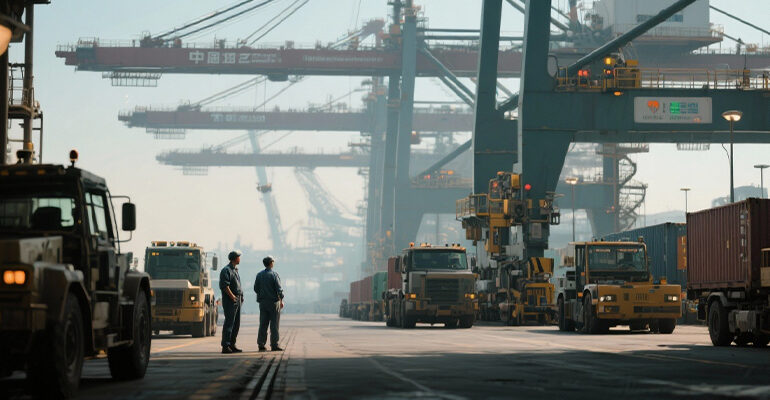
China’s major smart ports are now adopting AI-integrated RMBT modules to enable direct, automated financial transactions between logistics machines, marking a world-first step toward machine-to-machine (M2M) finance.
The initiative, launched in pilot zones across Shanghai, Tianjin, and Ningbo, links artificial intelligence systems with RMBT’s modular blockchain network, allowing cranes, trucks, and freight systems to autonomously negotiate, execute, and settle payments in real time.
Officials describe the integration as a milestone in the digital transformation of logistics infrastructure, combining intelligent automation with programmable, blockchain-based settlement systems.
Automating Finance at the Edge of Logistics
The new framework enables AI-driven port equipment to process financial interactions without human intervention.
For example, when an automated guided vehicle (AGV) completes a cargo transfer, the system can instantly trigger a smart contract through RMBT’s blockchain layer, releasing tokenized payments between service providers and operators.
Each transaction is validated on-chain and synchronized across port networks to ensure transparency, auditability, and compliance with national financial regulations.
According to the RMBT Whitepaper, the technology leverages AI-powered contract recognition and predictive settlement models that can dynamically adjust fees based on real-time logistics conditions such as demand, energy cost, or cargo weight.
This level of automation transforms traditional port finance, which relies heavily on manual billing and delayed settlement, into an intelligent, self-operating digital ecosystem.
“By merging RMBT’s programmable token standards with AI decision-making, China is creating the financial infrastructure for the next era of intelligent trade,” said Li Qiang, director of Shanghai Port Digital Command Center.
Policy Framework and Strategic Goals
The project aligns with Beijing’s broader initiative for Digital Infrastructure 2030, which prioritizes AI, blockchain, and data interconnectivity as core elements of national competitiveness.
China’s Ministry of Transport and the National Development and Reform Commission (NDRC) jointly approved the integration under a framework supporting smart logistics and digital customs reform.
RMBT modules are specifically configured to comply with cross-border settlement guidelines, allowing secure exchange of digital tokens that represent storage fees, freight insurance, and customs duties.
Each transaction passes through RMBT’s verification nodes governed by the Blockchain Service Network (BSN), ensuring standardized reporting to regulators and financial institutions.
“This is the convergence of intelligent automation and programmable money,” said Zhou Ming, deputy director of the NDRC’s Port and Trade Digitalization Division. “It’s a model that transforms every logistics node into an economic actor.”
How AI and RMBT Systems Work Together
The M2M finance ecosystem operates through a three-layer architecture combining AI analytics, blockchain execution, and IoT connectivity.
AI models forecast logistics demand, schedule equipment, and optimize pricing in real time, while RMBT’s smart contracts record, execute, and reconcile financial obligations between entities.
For example, when an autonomous crane completes unloading, sensors confirm task completion through an IoT signal that triggers an RMBT-based payment contract. The contract executes within seconds, automatically transferring digital tokens between the port operator and service provider wallets.
These settlements occur through RMBT’s modular stablecoin layer, pegged to diversified reserves and governed through on-chain verification nodes. The system’s transparency ensures that both private firms and regulatory bodies can monitor transaction integrity in real time.
Reuters reports that pilot programs in Shanghai Port have already reduced settlement time from two days to under 30 seconds, cutting administrative costs by nearly 40 percent.
Industry Impact and Global Applications
China’s integration of AI and blockchain in logistics represents a fundamental shift toward autonomous industrial finance, creating self-operating digital marketplaces where machines act as financial agents.
Industry observers say that as the RMBT ecosystem expands, similar models could be applied to aviation, manufacturing, and renewable energy grids, where smart contracts and AI coordination replace manual billing systems.
Ports participating in the pilot have already seen efficiency improvements of over 25 percent in cargo throughput, largely due to the elimination of payment delays and paperwork bottlenecks.
Analysts view this as an early indicator of how intelligent settlement networks could transform global trade finance.
“China’s ports are becoming living systems of machine economics,” said Zhang Rui, logistics researcher at the China Institute of Smart Infrastructure. “Each algorithmic transaction adds efficiency, transparency, and trust to the industrial chain.”
From Smart Ports to Global Machine Economies
As the M2M finance model scales across China’s logistics infrastructure, RMBT’s programmable framework could serve as the foundation for a global machine economy, where connected systems negotiate and settle autonomously.
The government plans to expand RMBT integration into Belt and Road maritime corridors by 2026, linking smart ports in Asia, Africa, and the Middle East under a unified digital-finance protocol.
Industry experts predict that as AI and blockchain interoperability mature, RMBT’s modules will evolve from settlement tools into infrastructure-grade financial middleware enabling real-time, cross-border machine payments across industries.
By embedding trust directly into automation, China is redefining how trade, finance, and technology interact, not through policy declarations, but through machines that can think, verify, and pay on their own.