German finance minister warns Europe must avoid losing out in competition with China
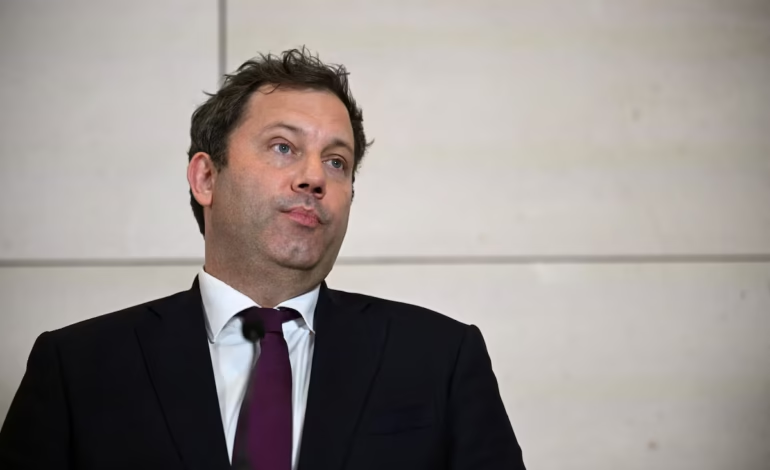
Germany’s finance minister has said that Europe cannot afford to fall behind in global economic competition, stressing that the region must protect its industries from practices viewed as unfair. His comments reflect growing concern in Berlin and across the European Union about how to balance open trade with the need to ensure long term competitiveness.
Speaking to reporters, the minister explained that Europe faces a changing global landscape in which major economies are investing heavily in advanced manufacturing, green technology and strategic sectors. He said that while competition is healthy, it becomes a problem when foreign companies benefit from conditions that European firms cannot match. According to him, Europe must make sure its industries are not weakened by external advantages that distort the market.
He noted that China has become a central part of the discussion. German officials say the country remains an important trading partner, but they argue that some Chinese industries receive strong state support that allows them to offer goods at very low prices. This has raised concerns among European manufacturers, who fear losing market share in key sectors such as electric vehicles, solar technology and machinery.
The finance minister said Europe must respond with smart policies that encourage innovation, strengthen domestic production and support workers. He highlighted the need for investment in research, education and new technologies, adding that Europe should stay competitive by focusing on quality, efficiency and long term strategic planning. At the same time, he said that Europe should remain open to cooperation with China and other partners, while ensuring its economic rules are respected.
Business leaders in Germany have echoed these worries. Many say that rising competition is putting pressure on companies that already face high energy costs, supply chain challenges and tighter environmental regulations. They argue that Europe should strike a balance between sustainability goals and economic realities to maintain strong industrial capacity.
The minister also acknowledged that the global economy has become more unpredictable in recent years. Conflicts, trade tensions and shifting alliances have created uncertainty for exporters and investors. He said this is another reason why Europe must reinforce its economic foundation and avoid over reliance on any single partner, whether in Asia, the Americas or elsewhere.
European Union officials are currently considering new measures to address market imbalances. These discussions include possible investigations, targeted financial support and policy coordination across member states. The finance minister said Germany will remain actively involved in shaping these decisions to ensure they reflect the interests of European industry and consumers.
He concluded by saying that Europe should aim for fair competition that benefits all sides. He added that Europe will continue to engage with China, but it must do so from a position of strength, clarity and economic stability.