
Domestic Substitution in AI Chips China’s Big Gamble
China is making a decisive push to replace foreign AI chips with domestic alternatives, marking a major shift in how the country responds to years of technology restrictions. After facing sustained pressure from United States export controls on advanced semiconductors and chipmaking equipment, Beijing is now moving from encouragement to directive. Companies are increasingly being told to use domestic AI hardware, even when it comes with higher costs or lower performance, as part of a broader strategy to reduce dependence on foreign suppliers.
Policy pressure reshapes chip demand
At the core of this shift is a policy driven effort to redirect demand away from foreign chips and toward Chinese alternatives. Data centers are being offered energy subsidies to compensate for the lower efficiency of domestic AI chips, making them financially viable despite technical disadvantages. Policymakers want workloads that previously relied on products such as Nvidia’s H20 to be absorbed by Chinese suppliers instead. This is not a market led transition but a coordinated intervention designed to force scale and learning across the domestic ecosystem.
Software adapts to local hardware
China’s large language model developers are adjusting quickly to the new reality. Models such as DeepSeek are releasing updated versions optimized specifically for domestic chips. Rather than chasing peak performance on the most advanced hardware, these developers are focusing on compatibility and efficiency within local constraints. This co development of software and hardware is intended to gradually close performance gaps while ensuring that domestic chips are actually used in production environments.
Spotlight on domestic chipmakers
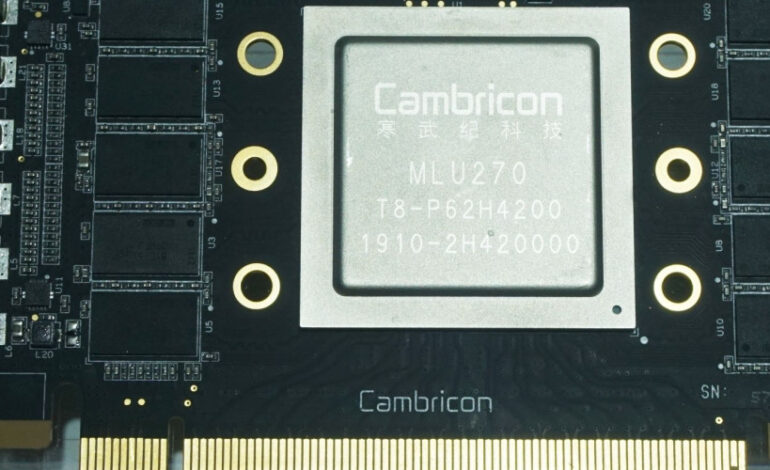
The policy shift has drawn new attention to Chinese AI chip companies. Huawei’s Ascend series has emerged as the de facto domestic standard, supported by the company’s strong system integration capabilities. Alongside Huawei, Cambricon is gaining momentum as an emerging competitor. Reports of Cambricon securing deals with major platforms such as Alibaba Cloud and ByteDance suggest that leading tech firms are preparing for a future where domestic chips play a central role, regardless of short term limitations.
Supply chain localization accelerates
The push for domestic substitution extends beyond chip designers to the wider semiconductor supply chain. Chinese suppliers such as silicon wafer producer Eswin are benefiting from increased demand as local manufacturing scales up. Memory remains a critical bottleneck, particularly high bandwidth memory used in advanced AI chips, which is subject to export restrictions. In response, Chinese firms are experimenting with replacing this component using large quantities of DDR5 memory, which is cheaper, lower in bandwidth, and more readily produced at home.
Alternative architectures gain traction
Breaking reliance on Nvidia’s graphics processing units also means rethinking chip design itself. Several Chinese companies and research teams are pursuing alternative architectures tailored for AI workloads. Startup Zhonghao Xinying has announced a home grown GPTPU chip, an application specific integrated circuit inspired by Google’s TPU design. Meanwhile, a research team at Peking University has reported progress on analog chips that offer significant speed advantages for certain computing tasks. These efforts reflect a willingness to explore unconventional paths rather than directly replicate Western designs.
Risks and long term stakes
China’s domestic substitution drive carries clear risks. Domestic AI chips are currently less powerful and less abundant than their Western counterparts, and forcing adoption could raise costs and slow innovation in the short term. Yet Beijing appears willing to accept these trade offs in exchange for strategic autonomy. By guaranteeing demand and aligning policy, capital, and engineering talent, China is betting that scale and iteration will eventually narrow the gap.
A calculated bet on self reliance
Domestic substitution in AI chips is not simply an industrial policy but a strategic gamble. Success would reshape China’s position in the global AI race and reduce vulnerability to external pressure. Failure could leave Chinese firms stuck with inferior tools in a fast moving field. For now, Beijing is signaling that self reliance outweighs efficiency, and that the long game matters more than immediate performance.



