Another Shady Polymarket Account Turned $30k Into $400k Just Before Maduro’s Capture
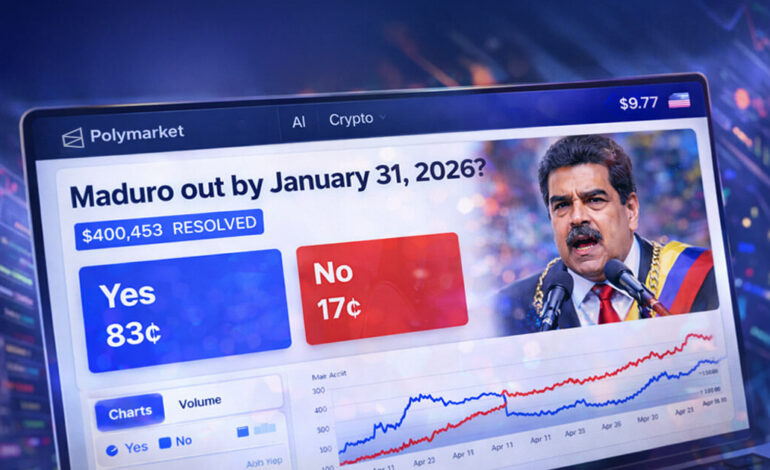
A perfectly timed trade raises serious questions
A dramatic and highly profitable trade on the crypto based prediction platform Polymarket has triggered fresh controversy after an anonymous account reportedly turned roughly $30,000 into nearly $400,000 moments before the United States captured Venezuelan President Nicolás Maduro. The timing of the wager has sparked widespread suspicion across crypto, political and regulatory circles, with many questioning whether the outcome was luck or something far more troubling.
The account in question appeared shortly before the event, placed a large bet on an outcome that most traders viewed as highly unlikely, and exited with massive profits almost immediately after the news became public.
How prediction markets amplify political risk
Prediction markets like Polymarket allow users to speculate on real world events ranging from elections to geopolitical outcomes. Prices are meant to reflect collective belief about probability, based on publicly available information.
In theory, these markets reward insight and analysis. In practice, they also create incentives for those with early or privileged information. When outcomes involve covert military operations or sensitive diplomatic actions, the line between speculation and exploitation becomes dangerously thin.
Why this trade stood out
What made this case unusual was not just the size of the profit, but the precision of the timing. The market had assigned a relatively low probability to Maduro being captured. Then, just before the operation occurred, a newly created account placed a disproportionately large bet on that exact outcome.
Within hours, the position multiplied in value. For experienced traders, this kind of timing is rare even in volatile markets. For observers, it looked less like intuition and more like foreknowledge.
Anonymity and accountability collide
Crypto prediction markets operate largely through anonymous wallets. While this protects user privacy, it also complicates accountability. Unlike traditional financial markets, there are limited mechanisms to investigate whether trades were influenced by non public information.
This structural gap fuels suspicion whenever geopolitical bets resolve in dramatic fashion. Without transparency, platforms struggle to distinguish between exceptional luck and potential misuse of insider knowledge.
The ethics of betting on real world conflict
Beyond legality, the incident has reignited debate over whether it is ethical to profit from events involving violence, political upheaval or loss of life. Critics argue that prediction markets turn human suffering into speculative instruments, rewarding those who benefit financially from instability.
Supporters counter that markets reflect reality rather than create it, and that information aggregation can even improve public understanding. The Maduro trade, however, has exposed how uncomfortable that argument becomes when profits appear tied to state level secrecy.
Regulatory pressure is building
Events like this add momentum to calls for tighter oversight of prediction markets. Policymakers are increasingly concerned that platforms dealing with political and security outcomes may attract actors with access to sensitive information.
While crypto markets have long operated in regulatory grey zones, high profile cases make inaction harder to justify. The question is not only whether rules should exist, but how they can be enforced in decentralised systems.
What this means for Polymarket and similar platforms
For Polymarket, the controversy is another test of credibility. Repeated incidents involving improbably timed trades risk damaging trust among users and regulators alike.
Platforms may be forced to introduce stronger monitoring, limit certain types of markets, or cooperate more closely with authorities. Doing nothing could invite heavier external intervention later.
A warning sign for the future of crypto prediction markets
This case highlights a broader vulnerability in the crypto ecosystem. As markets expand into sensitive real world domains, the consequences of abuse grow more serious. The combination of anonymity, global access and political volatility creates a fertile environment for controversy.
Whether the $30k to $400k trade involved inside knowledge may never be conclusively proven. But the perception alone is enough to raise alarms.
In an era where finance, technology and geopolitics increasingly intersect, prediction markets face a reckoning. Either they evolve to address these risks, or they risk becoming symbols of everything critics fear about unregulated crypto finance.