China navy escorts urged to expand energy protection
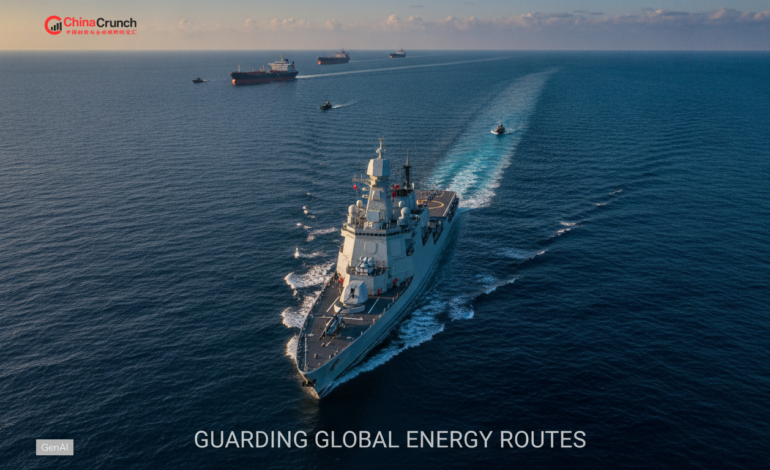
Why China navy escorts matter for energy security
Beijing faces growing pressure to harden maritime protection as insurers and shippers price in higher risk across key sea lanes. In recent commentary carried by Reuters, several Chinese energy and shipping stakeholders argued that China navy escorts should be strengthened with clearer rules for mission tempo, replenishment, and coordination with commercial operators. Some analysts indicate that escort readiness is increasingly not just about hull numbers, but also about onboard sensors, shipborne helicopters, and secure communications that can track drones and small craft. The same Reuters coverage noted concerns about rising security costs linked to Red Sea and Gulf spillovers. China’s Ministry of National Defense has repeatedly said its forces contribute to safeguarding international sea lanes, according to “China urged to strengthen navy escorts and find other routes to secure energy supply.”
Middle East conflict risks and China navy escorts
Energy traders and logistics managers are recalculating timelines as Middle East conflict disruptions push more vessels to detour, increasing transit time and fuel burn. Inside China’s policy debate, China navy escorts are being discussed alongside energy supply security being framed as a transport problem as much as a procurement issue. For Pakistan linked infrastructure planning that intersects with regional supply corridors, see Chinese investment in Pakistan reshapes energy planning for context on how governments align power and transport priorities. The International Energy Agency has warned that geopolitical shocks can tighten markets quickly when spare shipping capacity is limited, raising premiums even without a sustained supply outage. Reuters has also documented how reroutings around the Cape of Good Hope can amplify freight costs for Asia bound cargoes.
Alternative routes and redeployment limits
State owned firms and private refiners are examining alternative routes that reduce exposure to chokepoints, even if they come with higher baseline costs. Reuters has reported that some cargoes have shifted scheduling to avoid peak risk windows, while others have accepted longer voyages to lower insurance uncertainty. Within this route diversification debate, China navy escorts are being evaluated for how quickly they can redeploy between the Gulf of Aden, the Arabian Sea, and approaches to the Malacca Strait. For a related view of strategic force allocation, US China military focus: Navy shift to the Pacific outlines how naval planners weigh competing theaters. To sustain operations during longer transits, planners are discussing additional bunkering access, more flexible charter terms, and pre positioned spare parts for escorting vessels.
Industry proposals: rules, sensors, and coordination
Industry analysts are urging clearer operating concepts that separate deterrence patrols from close convoy protection, so commercial partners can plan schedules and contracts with less ambiguity. Reuters coverage highlighted calls for tighter coordination among shipowners, insurers, and naval units, including standardized reporting channels when threats emerge. For situational context on China’s emphasis on stability as a policy asset, see Tycoon Gordon Wu says he’s very optimistic about China due to its ‘stability’. Some specialists also argue that technology upgrades may offer faster gains than fleet expansion, pointing to better maritime domain awareness, improved electronic warfare resilience, and encrypted ship to shore links. These proposals aim to make protection predictable without escalating tensions.
Long term strategy beyond China navy escorts
Longer term planning is converging on redundancy, diversified import contracts, and infrastructure that can absorb shocks without forcing abrupt demand cuts, including pipelines, ports, and refineries tied to coastal hubs such as Ningbo Zhoushan. The International Energy Agency has consistently emphasized that strategic stocks and flexible supply chains reduce vulnerability when shipping routes are disrupted. For a snapshot of how stability themes carry into industry narratives, China semiconductor industry gains momentum on stability provides additional context. In China’s case, policymakers are also linking port capacity, refinery configuration, and pipeline connectivity to the same risk map used for maritime security. China navy escorts are likely to remain one tool in a wider portfolio that includes commercial risk management, regional diplomacy, and investment in monitoring systems that flag threats early. Maintaining credible protection while preserving freedom of navigation will require disciplined messaging, transparent deconfliction practices, and steady support for international anti piracy frameworks.