US China military focus: Navy shift to the Pacific
US China military focus: what the pivot means now
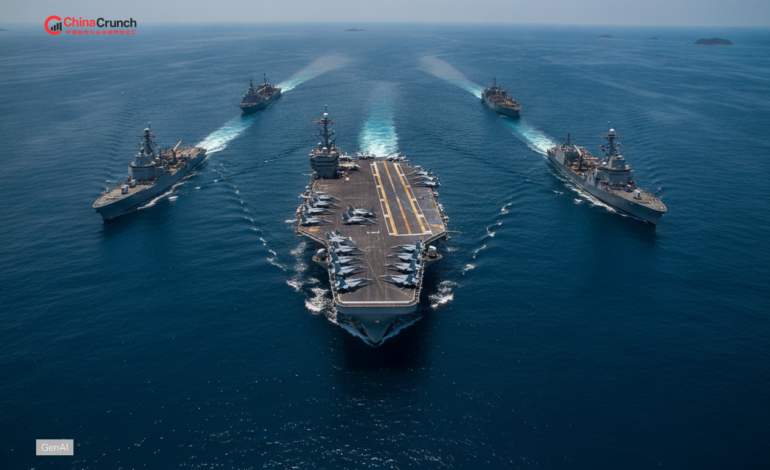
According to available reports, Pentagon planners are redirecting attention to the western Pacific as naval deployments adjust after intensive operations in the Middle East. In congressional testimony on March 12, 2024, Defense Secretary Lloyd J. Austin III noted that China is the pacing challenge for the Department of Defense, a formulation the Department has used publicly in recent years to explain force planning priorities. This reflects the US China military focus shaping how the Navy allocates carrier strike groups, destroyer squadrons, and patrol schedules. The near term signal is less about slogans and more about routine patterns of presence, patrol, and port calls tied to Indo Pacific commitments and readiness, as indicated by strategy discussions.
Policy signals behind the naval rebalancing
Public strategy documents and budget requests have pointed to the Indo Pacific as the priority theater, and officials say operational tempo is being recalibrated accordingly. The 2022 National Defense Strategy identifies the People’s Republic of China as the most consequential strategic competitor, and defense planners indicate that guidance continues to influence fleet planning in 2024. In practice, this orientation shows up in maintenance windows, surge capacity decisions, and the order in which units return to the Pacific after deployments elsewhere, rather than a single headline announcement. A parallel economic backdrop is also influencing political messaging, as covered in US-China trade tensions rise as China hits US tariffs.
Operational changes: carriers, maintenance, and readiness
Operationally, any redistribution depends on timelines for maintenance, munitions replenishment, and crew rotation, which can constrain how quickly ships can be re-tasked. Navy readiness also depends on shipyard capacity and spare parts pipelines, and Navy leaders have publicly highlighted maintenance backlogs as a limiting factor. Analysts also track how industrial policy and technology controls shape defense supply chains, a theme explored in China tech overproduction dispute hits EV exports. Commanders in the Pacific region typically prioritize assets that improve surveillance, air defense, and undersea awareness, since those capabilities are widely viewed as central to deterrence and early warning.
Allies and Southeast Asia: access, exercises, and politics
For Southeast Asian partners, the most immediate impact can be practical: more ship visits, more joint training slots, and more visible presence in busy sea lanes, depending on available hulls and schedules. In this context, US Navy redeployment is read as reassurance by some capitals and as a pressure point by others that prefer not to be drawn into major power competition. Governments that host or support visiting forces weigh sovereignty sensitivities against the benefits of maritime domain awareness and capacity building. Regional navies often seek exercises that emphasize humanitarian assistance, search and rescue, and anti piracy to keep cooperation useful without making every deployment a political signal. The US China military focus will be judged locally by whether activity stays predictable and coordinated.
Risks, rules at sea, and what to watch next
Diplomatically, the shift could raise the stakes for crisis management channels between Washington and Beijing, especially around close encounters at sea. The US China military focus is closely tied to whether hotlines and working level talks are used quickly after incidents, as officials have encouraged. The US Navy has pointed to the Code for Unplanned Encounters at Sea as a baseline for predictable behavior, while Beijing’s Ministry of National Defense has criticized what it describes as external interference near disputed areas in public statements. A marker to watch is the pace and scale of freedom of navigation operations and major exercises through 2024 and 2025, alongside de escalation steps such as agreed protocols and more transparent transit patterns.