Type 054B Frigate Imagery Shows 50% More VLS Cells
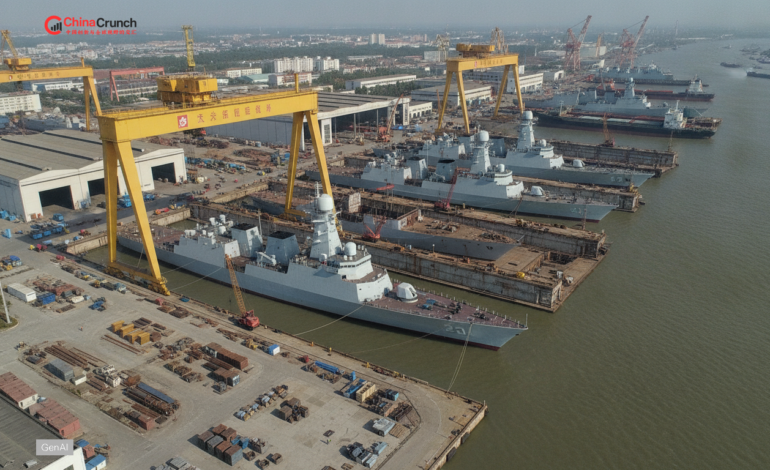
Type 054B frigate imagery: what the new photos show
New commercial satellite imagery is sharpening outside assessments of the Type 054B frigate and its forward deck layout. Analysts at the Center for Strategic and International Studies’ Asia Maritime Transparency Initiative highlighted visible changes around the bow area and superstructure that point to a larger vertical launch system footprint than earlier expectations. In the same set of images, the Type 054B frigate appears configured with additional launch positions that may lift total missile capacity by roughly 50% compared with prior assumptions, a figure cited by the South China Morning Post’s reporting on the imagery. The change matters because it implies tighter integration between sensors, combat management, and magazines.
Why more VLS cells matter for escort missions
A higher cell count changes how commanders can allocate weapons for air defense, anti surface work, and land attack in a single sortie. If the roughly 50% increase holds, it may enable more simultaneous interceptors without immediately sacrificing other loadouts, and it could improve the ship’s ability to stay on station after expending part of its magazine. For readers tracking regional flashpoints, the security context is closely followed alongside broader cross Strait dynamics, as covered in Taiwan China Coast Guard Standoff: Taiwan Arms Up, and it improves the ship’s ability to stay on station after expending part of its magazine. That endurance can reduce the need for nearby replenishment or rapid rotation, especially under persistent air and missile pressure.
How Type 054B frigate magazine depth compares globally
The practical benchmark for a modern escort is how many intercept attempts it can sustain before returning to reload. In the imagery described by the South China Morning Post, the revised arrangement suggests a frigate moving closer to the magazine depth that many navies reserve for larger destroyers, even if it still lacks the displacement and power margins of top tier area air defense ships. CSIS’ Asia Maritime Transparency Initiative has argued that shipyard patterns and deck layouts can reveal pacing and priorities in fleet construction, which is why observers scrutinize the VLS footprint as closely as masts and apertures; for a broader view of China’s industrial base supporting advanced systems, see Chinese chipmakers profit rises on AI foundry demand. For a broader view of China’s industrial base supporting advanced systems, see Chinese chipmakers profit rises on AI foundry demand.
Regional planning effects of a larger missile magazine
More cells on an escort ship can change regional planning because it increases the number of defended assets a task group can cover while keeping a reserve for later waves. CSIS’ Asia Maritime Transparency Initiative has previously noted that improved air defense capacity on escorts can free higher end ships for offensive roles, a shift that complicates adversary targeting and strike timing during saturation scenarios; in the wider technology ecosystem, supply chain signals affect how quickly new platforms can be fielded, and related indicators include AI demand drives triple-digit profit growth for Chinese chip foundries SMIC, Hua Hong. The imagery driven conclusions also intersect with broader debates over distributed lethality and the resilience of naval formations under sustained missile exchanges.
What to watch next for Type 054B frigate deployment
What follows from the new imagery is a test of how rapidly the platform’s combat system can mature into reliable fleet service. CSIS’ Asia Maritime Transparency Initiative has emphasized that hull production and combat system integration often move at different speeds, so magazine growth must be matched by sensor performance, fire control stability, and consistent missile availability, and the Type 054B frigate remains the reference point for these tradeoffs. A larger vertical launch system also raises the premium on training and doctrine because crews must manage more complex inventory choices while maintaining anti air defense readiness under electronic attack. The Type 054B frigate will be watched for signs of standardized loadouts across batches, which would indicate designers have settled on a preferred mix of interceptors and multi mission weapons.