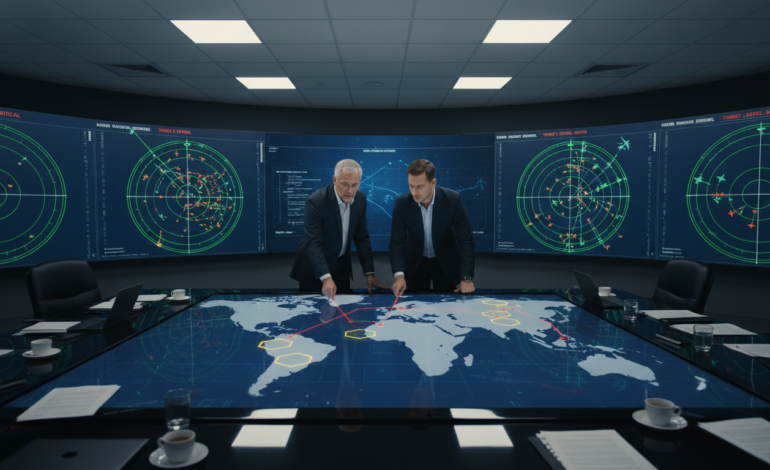
Managing China-US AI rivalry amid nuclear risks

China and US AI Competition: A Global Perspective
Today, Washington and Beijing are moving from chip controls to model deployment choices that shape how fast military AI enters real operations. In commercial labs, Live product releases are tightening feedback loops between frontier models and specialized hardware, which shortens the time between prototype and fieldable capability. In this climate, US-China relations are increasingly tested by dual use innovation rather than only by tariffs or sanctions. The South China Morning Post opinion piece frames the core concern as crisis instability when rivals race without sustained dialogue. Officials on both sides now treat ai updates from leading firms as signals of national intent, not just market news. This pressure is already being felt across allies that host critical supply chains.
Implications of AI in US-China Relations
Diplomats tracking Today’s strategic balance are watching how AI is inserted into intelligence fusion, early warning, and targeting workflows, because those changes can compress decision time. The South China Morning Post argues that absent routine talks, misread signals could escalate under nuclear constraints, and that point is now echoed in policy circles that monitor Live crisis management drills. For readers following the current debate, SCMP analysis on AI contest in a nuclear age (https://www.scmp.com/opinion/china-opinion/article/3354110/us-and-china-must-talk-manage-dangers-ai-contest-nuclear-age?utm_source=rss_feed) underscores why guardrails cannot wait for a future summit. Separately, Putin China visit set to deepen strategic ties (https://cheenews.com/putin-china-visit-set-to-deepen-strategic-ties/) highlights how third party alignments complicate signaling during fast moving ai updates. Update cycles in both capitals are now driven by perceived relative advantage, not just absolute capability.
Managing the Risks of AI in the Nuclear Age
Risk management is becoming operational, not theoretical, as militaries integrate AI into sensors, cyber defense, and decision support where errors can propagate quickly. Analysts focused on the nuclear age warn that automation bias and data poisoning can create false confidence during confrontation, and the SCMP piece stresses that direct communication is the simplest hedge. Live monitoring tools can improve verification but they can also create alert floods that leaders interpret as hostile preparation. In the middle of these debates, US-China relations are increasingly shaped by how command authorities in Washington and Beijing define human oversight under time pressure. The immediate priority is clarifying what stays human controlled, especially around launch authorization and strategic warning. Today’s practical work is about shared definitions, incident reporting channels, and testing protocols that reduce surprise. Update discipline matters too, since rapid model changes can alter behavior in ways operators do not anticipate.
Strategies for Diplomatic Engagement
Governments are now exploring narrower, technically specific dialogues that can survive broader disputes, including channels between defense, foreign affairs, and standards bodies. A workable approach is to focus on crisis communications that acknowledge AI driven ambiguity, with pre agreed procedures for verifying anomalies before escalation. In the current climate of US-China relations, an Update to hotline protocols that includes cyber and AI incidents would address the most likely triggers for misinterpretation. For context on the wider security environment, Liaoning Carrier Drills Raise Japan Tension Levels (https://chinacrunch.com/liaoning-carrier-drills-raise-japan-tension-levels/) shows why conventional activity can intersect with Live information operations and heighten alertness. Officials also need shared language on what constitutes unacceptable interference with strategic warning systems, a point frequently discussed in arms control scholarship. Today, credible engagement means measurable steps, not symbolic meetings.
Future Outlook: AI and Global Stability
Near term stability will hinge on whether leaders treat AI governance as part of strategic stability, rather than as a separate tech agenda run only through trade or industrial policy. The SCMP commentary emphasizes that dialogue must be continuous, because AI competition produces frequent capability leaps that change perceived risk. Today’s most realistic benchmark is whether each side can keep communications open during crises while maintaining deterrence, a balance that depends on trust in procedures more than trust in intentions. Live operational learning will continue as systems are deployed in intelligence and defense support roles, which makes transparency about safety testing increasingly important. For US-China relations, the most consequential signal will be an Update that converts informal expert exchanges into sustained governmental mechanisms. The nuclear age leaves little margin for miscalculation, so governance must move at the speed of deployment.