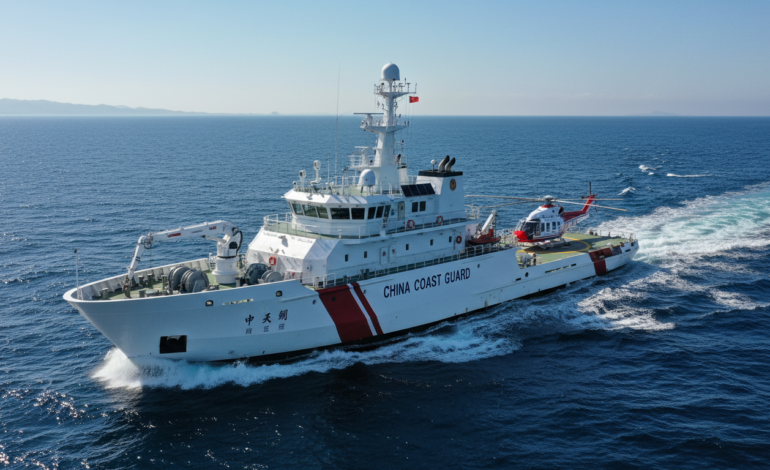
China steps up Hormuz sea lane security planning

China’s Strategic Interests in the Strait of Hormuz
Beijing is moving quickly to map exposure in the Strait of Hormuz as regional tensions sharpen the risk of disruption to energy and container flows. Today, policy researchers and shipping analysts are treating the chokepoint as a stress test for supply continuity across Asia. In its current briefings, China maritime security is framed as a trade resilience issue rather than a narrow naval debate, with planners focused on keeping commercial routing options open during a Live crisis environment. The International Energy Agency describes the strait as the world’s most important oil transit chokepoint, a benchmark Chinese planners use in internal scenario work. An Update cycle of threat assessments is now being folded into trade and industrial planning.
Current Challenges Facing China’s Maritime Security
Chinese operators are confronting a cluttered security picture in the Gulf, where shipping insurance, rerouting costs, and escort expectations can change quickly. Today, commercial risk teams rely heavily on incident alerts and real time advisories to keep vessels moving while avoiding escalatory behavior at sea. The Live operating environment is complicated by overlapping naval patrols, militia style harassment claims, and the need to comply with multiple jurisdictions at once. For a baseline on the level of strategic exposure, analysts often cite the U.S. Energy Information Administration overview of Hormuz volumes in EIA Strait of Hormuz chokepoint analysis, which is used widely in maritime risk models. China maritime security planners are also tracking how quickly an Update can shift freight pricing and charter terms in Asia.
Research Initiatives to Protect Trade Corridors
China has responded by ordering tighter research outputs that connect trade corridors to enforceable operational playbooks, including route diversification and port coordination across the Indian Ocean. Today, some of the work is being routed through academic maritime institutes and state linked think tanks that model convoy procedures, communications resilience, and satellite based domain awareness. A related policy context on broader economic stakes is discussed in Global stakes around trade and diplomacy, which illustrates why planners prioritize continuity under pressure. China maritime security appears as a practical planning label in these studies, not a slogan, with Live drills designed to test response timelines. An Update stream of route risk scoring is also being standardized for shippers and insurers.
Geopolitical Implications of China’s Efforts
These steps carry clear geopolitical implications because any expanded Chinese presence near Hormuz intersects with U.S. and allied naval activity, plus the security agendas of Gulf states. Today, officials in the region judge outside involvement by whether it reduces risk for commercial shipping or adds friction through competing command structures. Beijing is signaling that sea lane protection should be predictable and rules based, while also emphasizing sovereign consent and de escalation. Chinese technology capacity is part of the enabling layer, as higher resolution sensing and faster modeling improve response planning; a parallel example of advanced computing progress is described in Chinese supercomputers and advanced modeling, which shows the direction of travel for complex simulations. Live coordination mechanisms will likely determine whether this posture produces stability or rivalry, with each Update scrutinized by multiple capitals.
Future Prospects for China’s Maritime Security
Near term prospects hinge on whether crisis management frameworks can keep merchant traffic moving without provoking confrontation among militaries operating in close quarters. Today, Chinese shipping interests are likely to push for clearer notification channels, standardized transit guidance, and stronger contingency contracts that reduce the cost of sudden diversions. China maritime security will remain tied to global trade risks because the chokepoint exposes how quickly upstream shock becomes downstream inflation, a linkage highlighted repeatedly by the International Monetary Fund in its trade and supply chain discussions. Live monitoring will increasingly blend naval awareness with commercial data feeds, while insurers demand auditable compliance steps from carriers. The next Update milestones are expected to focus on practical interoperability, not headline grabbing deployments, as Beijing tests what can be achieved through research, coordination, and selective capability upgrades.